Skip to content

When Seattle experiences another smoky summer, the city is ready with 5 clean air centers

City officials in Seattle have invested in 5 facilities with free clean and cool air for residents if and when wildfires fill local skies with smoke this summer. A recent article in the Washington Post online describes Seattle’s new program. Seattle is retrofitting 5 facilities that had central cooling with advanced air filtration systems. These systems will be able to filter out microscopic particulates that are especially dangerous for children, elderly people, and those with heart or respiratory conditions. Indoor air sensors will also be installed in the city facilities to measure the air quality. Dan Jaffe, Alex Margarito-Lopez (recent UW Bothell graduate), and Rebecca Rickett (UW Bothell student) will be working with the city to interpret data from these sensors.

In the past two summers, Seattle experienced increased air pollution from wildfire smoke, including 4 days last summer that reached levels of fine particulate matter that were unhealthy for all individuals. Most homes in Seattle do not have air conditioning or air filtration systems. Many residents rely on opening the windows to cool their homes in the summer. When the outside air is polluted with smoke, opening windows leads to a house filled with polluted air. The new clean air centers will offer residents somewhere to go to get out of the polluted air.

Wildfires in the West have been increasing in recent years. A major factor in the worsening wildfire picture is human-driven climate change, which is causing drier and warmer conditions. Seattle Mayor Jenny Durkan recognized that local governments need to step up “to be ready for the climate changes we’re experiencing in Seattle.” These centers are part of an effort to address climate change’s impacts.

The wildfire outlook is “strong wildfires, much larger than normal,”  Dan Jaffe says. “It’s going to get worse. How much worse we don’t know, but we need to adapt. Whether that’s thinking about clean air, cool spaces to go to during the daytime, or whether that means shoring up beaches, or whatever it means, communities across the country need to adapt to climate change.”
Read the full Washington Post Energy 202 article.

Wildfires are causing extreme PM in the western US

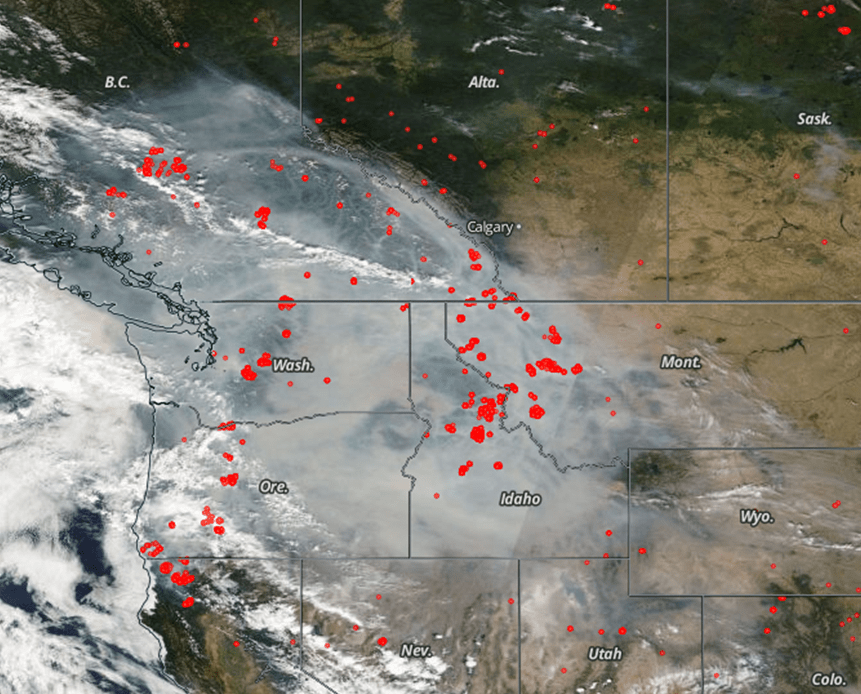
Wildfire smoke on 9/6/2017
Wildfire smoke covering the Pacific Northwest and British Columbia on September 6, 2017, from MODIS true color reflectance image. Red dots represent fire locations. Source: https://worldview.earthdata.nasa.gov.

New research by James Laing and Dan Jaffe shows how increases in wildfire smoke have impacted air quality in the western US. Their recent paper, published in the June 2019 issue of EM—The Magazine for Environmental Managers, describes the changing air quality picture for western states. Even though air quality in most of the US has improved in the last four decades, due in large part to the US Clean Air Act regulations, it is not improving in much of the western US. The reason for the decrease in air quality in western states is wildfire smoke.

In 2017 and 2018, wildfires caused the largest daily mean concentrations of fine particulate matter (PM2.5; particles with diameter less than 2.5 μm) ever measured at monitoring sites in the US. Some of the extreme PM2.5 events of 2017–2018 include the following:

  • Seeley Lake, Montana, September 6, 2017—Highest daily PM2.5 on record (642 μg/m3). In August-September 2017, there were 35 days with PM2.5 > 150 μg/m3 and 18 with PM2.5 > 250 μg/m3.
  • Ventura, California, December 6, 2017—PM2.5 of 557 μg/m3, with a two-week average concentration of 165 μg/m3.
  • Seattle, Washington, August 21, 2018—Highest daily PM2.5 ever recorded in Seattle (110 μg/m3).
  • Medford, Oregon, September 6, 2017—Highest daily PM2.5 ever recorded in Medford (268 μg/m3), and eight days over 100 μg/m3 in 2017.

To put these measurements in context, the US Environmental Protection Agency (EPA) has set the daily PM2.5 standard at 35 μg/m3 (98th percentile < 35 μg/m3, averaged over 3 years). The EPA has also defined PM2.5 > 150 μg/m3 as very unhealthy and PM2.5 > 250 μg/m3 as hazardous. PM2.5 is such a health hazard because it can travel deep into the respiratory system due to its small size. Despite the gains in air quality in the US, about 30 million people live where the PM2.5 standard is not being met.

The estimated increase in the number and size of wildfires in the future raises issues for public officials and environmental managers. Complying with air quality standards and reducing human exposure to PM2.5 are causes for concern in the western US now and going forward.

Read the full paper here