Popular Science recently took a look at how wildfires are polluting our air. They cited research about the increase in two pollutants due to wildfires: PM2.5 (fine particulate matter less than 2.5 micrometers in size) and ozone. This research, conducted by Dmitri Kalashnikov, a doctoral student in environmental science at Washington State University Vancouver, found the co-occurrence of these two pollutants has increased significantly in the last 20 years in the western U.S. during July–September, as wildfires have increased.
Dan Jaffe noted that understanding the relationship between PM2.5 and ozone levels isn’t straightforward. He and Jaffe Group researchers have previously found that the most extreme levels of PM2.5 and ozone tend notto occur on the same days. He says that the new paper is still “definitely a step forward.”
Understanding and responding to the increase in wildfires and their unhealthy pollution are important issues for western communities and policy makers.
“The impact of wildfire smoke on ozone production in an urban area: Insights from field observations and photochemical box modeling”
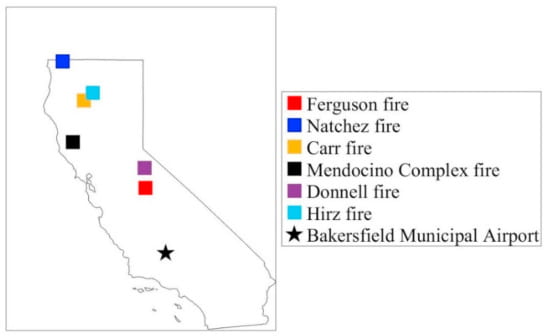
Map of California showing the locations of the Bakersfield Municipal Airport (BMA) site and the Ferguson, Natchez, Carr, Mendocino Complex, Donnell, and Hirz fires.
In this recently published paper, postdoctoral research associate Matt Ninneman and Dan Jaffe examined the effect of wildfire smoke on ozone (O3) production at an urban site in Bakersfield, CA. They used data from smoky and non-smoky weekdays in summer 2018. During this period, there were several active wildfires in northern California. The authors utilized a photochemical box model to analyze the data. The box model simulations indicate that maximum O3 production rates were about two times faster on smoky weekdays compared to non-smoky weekdays. Model sensitivity tests for smoky weekdays showed that (1) O3 was sensitive to both oxides of nitrogen (NOx) and volatile organic compounds (VOCs) and (2) aldehydes significantly affected O3 formation. Their results suggest that “a combination of anthropogenic VOC and NOx reductions will be the most effective strategy for decreasing O3 on typical non-smoky days.” However, only reductions in NOx are expected to have a significant impact on lowering O3 concentrations on typical smoky days, since VOC levels in smoke plumes are high.
“Observed relationship between ozone and temperature for urban nonattainment areas in the United States”
In a second recently published paper, Matt Ninneman and Dan Jaffe investigated the observed relationship between ground-level ozone (O3) and temperature from 1995 to 2020 at 20 U.S. cities that violate regulatory requirements for ground-level O3. They found that the median slope of the ground-level O3 versus temperature relationship declined in all regions, and the correlation between ground-level O3 and temperature weakened over time in the eastern and midwestern U.S. In the western U.S., ground-level O3 has declined more slowly and the correlation between ground-level O3 and temperature has changed negligibly due to the combined influence of high background O3 and wildfire smoke. This suggests that meeting regulatory requirements for ground-level O3 in the western U.S. will be more challenging than in other parts of the country.
The Washington Post interviewed Dan Jaffe for a recent article about the benefits of air purifiers against airborne particles such as those from coronavirus and also wildfires. The article offers advice on what to look for in an air purifier and how to use one. Their advice in a nutshell: use HEPA filters, fit the purifier to the space, set it up correctly, and use the purifier in the rooms where people are. And one more thing—there is an option that is cheaper than spending $200–1000 for a purifier! At the end of the article, they cite the Jaffe Group’s research into using a standard box fan with an attached MERV-13 furnace filter to clean particulate matter from the air. Making a simple air purifier is an easy project you can do at home. The article also mentions that wearing masks is important.
Congratulations to Dan Jaffe on his election to the Washington State Academy of Sciences (WSAS)! Jaffe was elected by members of the WSAS and recognized “for leadership in monitoring and understanding the global transport of atmospheric pollutants from energy production, wildfire, and other sources, as well as science communication and service that has informed citizens and enhanced public policy.” Jaffe has been at UW Bothell since 1997 and is also a professor at UW Seattle in the Department of Atmospheric Sciences. His research focuses on atmospheric chemistry, ozone photochemistry, wildfire smoke, and the long-range transport of pollutants. He has operated the Mt. Bachelor Observatory research station in Bend, Oregon, since 2004.
New members to the WSAS were chosen for “their outstanding record of scientific and technical achievement, and their willingness to work on behalf of the Academy to bring the best available science to bear on issues within the state of Washington,” according to the WSAS press release.
The WSAS is a not-for-profit organization that provides expert scientific and technical information to inform issues and public policy making in the state of Washington. It was established in 2005 and currently has over 300 elected members, all residing in Washington State.
Last summer was a smoke-filled one in Washington State. Will this summer be similar? Well, the drought conditions in Washington State have led to forests and grasslands filled with wildfire fuel. If you live in the Pacific Northwest, now is the time to prepare for the possibility of a smoky summer. Dan Jaffe was interviewed by KUOW recently and advised residents to get prepared. “You don’t have to spend a lot of money to actually do a pretty good job of protecting your indoor air quality.” You can make a simple smoke filter for your home with a box fan and a furnace filter.
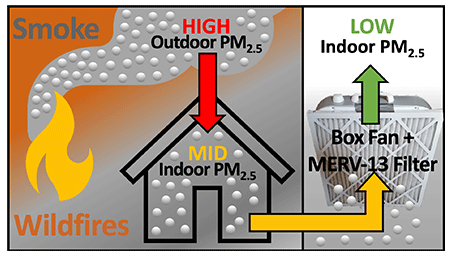
A new paper by group members Dr. Nate May, Clara Dixon, and Dr. Dan Jaffe evaluates the effectiveness of low-cost air filter units during wildfire smoke events. The increased wildland fire activity in the western US in recent years produces high concentrations of fine particulate matter (PM2.5), which negatively affects the health of millions of people. During wildfire smoke events, staying indoors is often recommended. However, how good is indoor air quality during smoke events? The authors looked at PM2.5 measurements from the PurpleAir sensor network, a publicly available network of low-cost air quality sensors located indoors and outdoors. They also analyzed the effectiveness of residential filter units in reducing indoor PM2.5. One low-cost DIY filtration method consists of attaching a Minimum Efficiency Rating Value-13 (MERV-13) fan filter to a standard box fan. This method was found to be highly effective at reducing indoor PM2.5 when recirculating air in a single room.
A new article on the University of Washington website looks at the growing severity of wildfires and the broad research that the university is doing on their impacts. The article highlights the work that we do on wildfires’ effects on air quality. Also featured is the Joel Thornton lab at UW Seattle and the work of other UW researchers who study wildfires and forests.
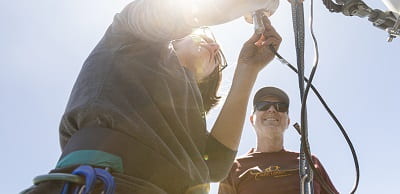
Claire Buysse and Dan Jaffe set up radiometers to measure UV light on the top of Mt. Bachelor Observatory, August 2019. Credit: Mark Stone/University of Washington.
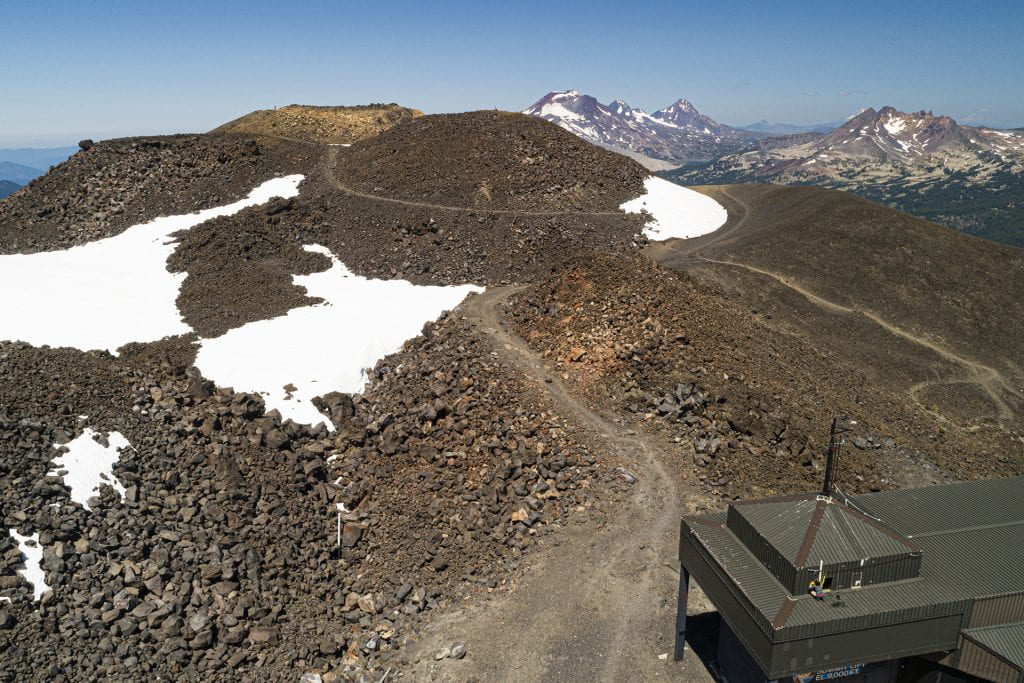
In the summer of 2019, UW photographer Mark Stone visited Mt. Bachelor Observatory, as well as other research sites, and captured the UW’s research in stunning photographs.
In September, Seattle and the Puget Sound region recorded the worst air quality ever. For example, in the Georgetown neighborhood of Seattle it was 314 on the air quality index on September 17. During our area’s recent smoke apocalypse, Dr. Dan Jaffe has been a frequent media guest. He has been interviewed by the Seattle Times, Crosscut, KIRO7, KOMONews, KOMOAM, KING5, and Q13Fox. Dan discussed his work on indoor air quality during the wildfire season and showed how to make a very effective DIY air purifier using a box fan and a MERV 13 furnace filter.
Have you wondered how effective your cloth mask is in protecting you from the COVID-19 corona virus? We wondered that too, and this led to our newest research project—studying the effectiveness of cloth face masks. Shahbaz Qureshi, a 2020 UWB Biochemistry graduate, and Praphulla Boggarapu Chandra, postdoctoral researcher, have been working with Dr. Dan Jaffe on testing mask effectiveness. Their research was featured on KIRO 7 news, where Dan Jaffe was interviewed by reporter Jessica Oh.
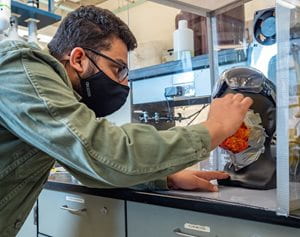
Shahbaz Qureshi adjusts a cloth mask on a mannequin head in an experiment testing the mask’s effectiveness. Photo credit: Marc Studer.
The preliminary research results show that for filtration, fit is more important than the mask material: Tight-fitting masks were twice as efficient in stopping aerosol particles as looser masks. “All masks reduce the particulate—the aerosols you’re putting out in the world and the aerosols you’re breathing in—both ways to some degree,” Jaffe said. “If you wear it properly and you have a tight-fitting mask, it reduces it a lot more.” Dr. Jaffe also plans to present the mask problem to his Quantitative Environmental Analysis class in the upcoming Autumn quarter. “Students will for themselves see: How good is my mask, and how important is the fit?”
Dr. Dan Jaffe is the lead author on a critical review that examines the processes that influence wildfires and prescribed fires and their effects on air quality in the U.S. This review, “Wildfire and prescribed burning impacts on air quality in the United States,” is published in the June issue of the Journal of the Air & Waste Management Association. This paper is the result of a collaboration between Dan Jaffe and Susan O’Neill, Narasimhan Larkin, Amara Holder, David Peterson, Jessica Halofsky, and Ana Rappold. These coauthors have brought their range of expertise to the issues related to wildland fires and have examined each of the processes influencing these fires and also the effects of the fires, “including the natural role of wildland fire, forest management, ignitions, emissions, transport, chemistry, and human health impacts.”
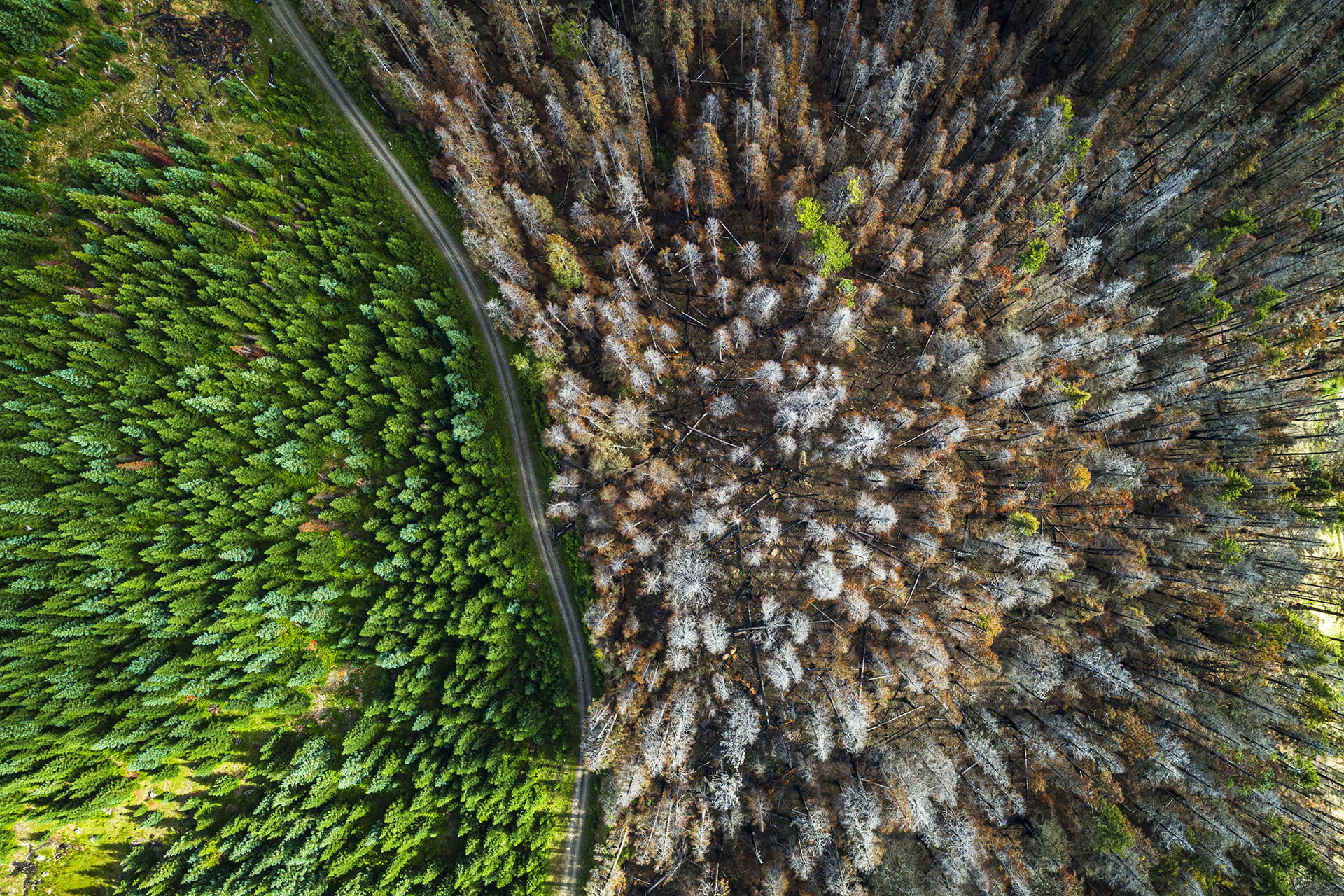
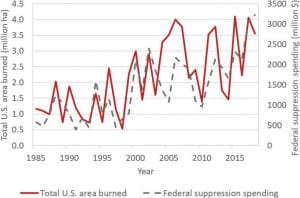
Large wildfires in the U.S. are becoming more common, and their emissions of particulate matter (PM) and gaseous compounds negatively impact air quality and human health. The air quality trend in the U.S. has been improving in the last decades. However, seasonal wildfires threaten to undermine this progress in parts of the country. The area burned by wildland fires has grown significantly in the last few decades due to “past forest management practices, climate change, and other human factors.” This has resulted in millions of people experiencing high levels of air pollution. As cities and towns have spread further into wildlands, costs for fire suppression (to protect human developments) and the consequences of fires have increased significantly.
Total U.S. wildfire area burned (ha) and federal suppression costs for 1985–2018 scaled to constant (2016) U.S. dollars. Trends for both wildfire area burned and suppression indicate about a four-fold increase over a 30-year period. Data source: National Interagency Fire Center, Fire Information Statistics, accessed December 2, 2019. https://www.nifc.gov/fireInfo/fireInfo_statistics.html.
In this review, Dr. Jaffe and his coauthors describe the current state of the research and identify key data gaps. Their goal is to identify areas that are well understood and areas that need more research. They recommend eight specific areas for future research.
 Congratulations to Dan Jaffe on his election to the