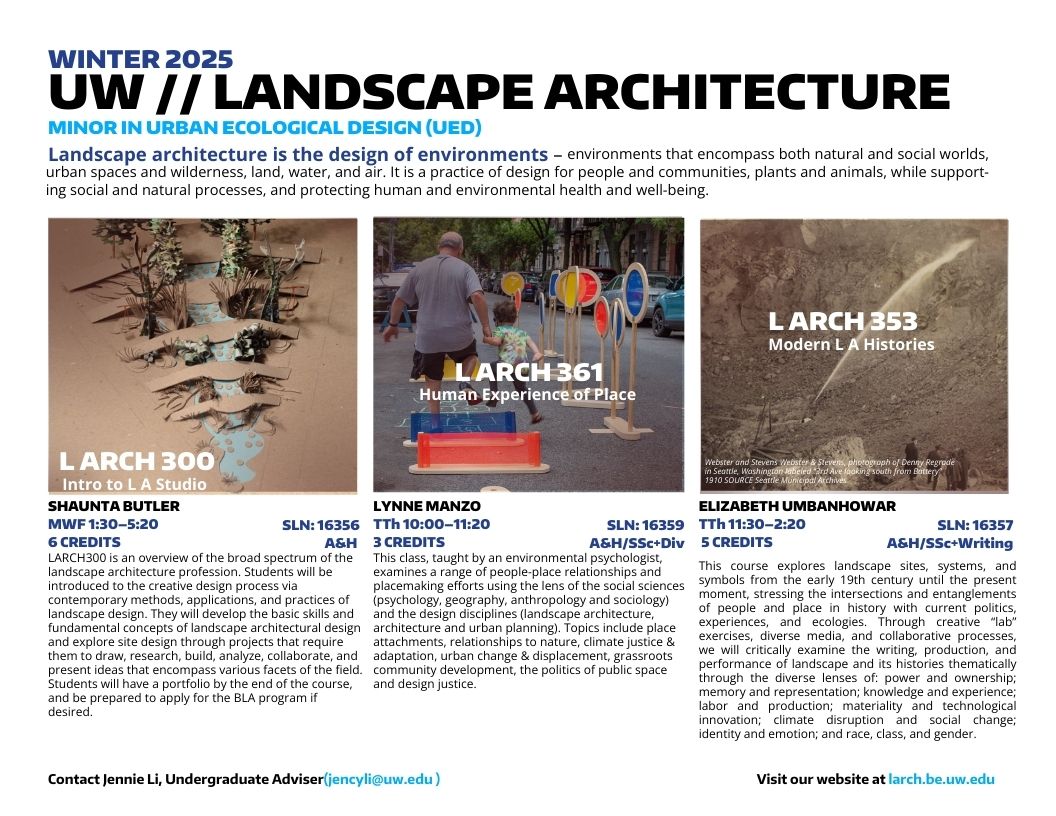
Shaunta Butler
6 credits A&H, BLA prerequisite
MWF 1:30-5:20
SLN: 16356
LARCH300 is an overview of the broad spectrum of the landscape architecture profession. Students will be introduced to the creative design process via contemporary methods, applications, and practices of landscape design. They will develop the basic skills and fundamental concepts of landscape architectural design and explore site design through projects that require them to draw, research, build, analyze, collaborate, and present ideas that encompass various facets of the field. Students will have a portfolio by the end of the course, and be prepared to apply for the BLA program if desired.
Lynne Manzo
3 credits A&H/SSc+Div, counts towards BLA major
TTh 10:00-11:20
SLN: 16359
This class, taught by an environmental psychologist, examines a range of people-place relationships and placemaking efforts using the lens of the social sciences (psychology, geography, anthropology and sociology) and the design disciplines (landscape architecture, architecture and urban planning). Topics include place attachments, relationships to nature, climate justice & adaptation, urban change & displacement, grassroots community development, the politics of public space and design justice.
Elizabeth Umbanhowar
5 Credits A&H/SSc+Writing, counts towards BLA major
TTh 11:30–2:20
SLN: 16357
This course explores landscape sites, systems, and symbols from the early 19th century until the present moment, stressing the intersections and entanglements of people and place in history with current politics, experiences, and ecologies. Through creative “lab” exercises, diverse media, and collaborative processes, we will critically examine the writing, production, and performance of landscape and its histories thematically through the diverse lenses of: power and ownership; memory and representation; knowledge and experience; labor and production; materiality and technological innovation; climate disruption and social change; identity and emotion; and race, class, and gender.
Laure Heland
3 Credits
W 6:00-8:50 PM
SLN: 16367
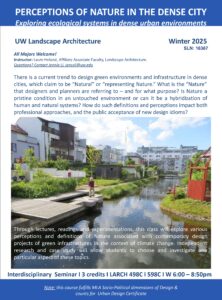
There is a current trend to design green environments and infrastructure in dense cities, which claim to be “Natural” or “representing Nature.” What is the “Nature” that designers and planners are referring to – and for what purpose? Is Nature a pristine condition in an untouched environment or can it be a hybridization of human and natural systems? How do such definitions and perceptions impact both professional approaches, and the public acceptance of new design idioms?


