
Salmonid Behavior and Life History – FISH 450
Goals
The purpose of this class is to familiarize students with the life history, behavior, and ecology of Pacific salmon and trout. The lectures provide detailed information on the marine distribution, homing migration, energetics, and spawning behavior of adult salmon, the ecological processes linked to their carcasses, the incubation and emergence of their offspring from gravel nests, the ecology of juveniles in streams and lakes, their seaward migration, and ecology at sea.
This class is fast-paced and information rich, and it is expected that students are already familiar with fish biology and ecological principles, and have also had experience processing data and writing scientific papers.
- Introduction, goals and course schedule
- General life history & distribution of Oncorhynchus, Salmo and Salvelinus
- Life histories and identification, continued
- Life histories compared with other N. A. fishes
- Global patterns of anadromy and catadromy; Speciation, glaciation
- Oceanic migration and orientation
- Coastal and estuarine migrations
- Upriver migrations, energetics, hormones
- Homing – evidence and patterns
- Homing mechanisms
- Selection of spawning site and female reproductive behavior
- Reproductive success of males
- Ecology of adult salmon: predators, scavengers and nutrient cycling
- Embryo mortality and incubation schedules
- Emergence and initial fry movements
- Sockeye fry in lakes: predation and feeding
- Salmon and trout in streams Part I & II
- Smolt transformation & physiology
- Seaward migration: timing, orientation
- Estuarine residence and migration
- Early marine migrations and distribution
- Survival at sea
- Feeding and growth at sea
- Age and size at maturity
- Population structure and local adaptation
- Successes and failures of transplants
- Effects of land-use activities on salmonids
- Wild salmon and hatcheries
- The future of salmon in a changing world
Aquatic Ecological Research in Alaska – FISH 491
Background

The University of Washington and the School of Aquatic & Fishery Sciences (SAFS), in particular, are interested in closely connecting undergraduate teaching and research.
As one step towards this goal, the school offers a course in aquatic ecology, started in summer 1999, at the Fisheries Research Institute’s field stations in Bristol Bay, Alaska
Goals
The goal of the course is to provide a small number of students with direct, hands-on training in the theories and techniques of research in aquatic ecology. We make use of the well-equipped field camps and diverse aquatic environments to give students formal course material (i.e., lectures and instruction manuals), directed research and independent projects.
Course Structure
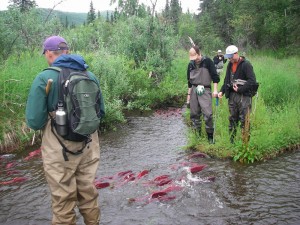
FISH 491 students in Bristol Bay, Alaska
All students will enroll in Fish 491 for 4 credits (graded) in summer quarter and will jointly participate in field and laboratory research at lakes Aleknagik and Iliamna. The course will run for about about a month, starting in mid-July. During that time students will receive instruction in limnology, juvenile fish ecology, spawning behavior and life history of adult salmon, population dynamics and fishery management. Students will have access to the long-term data sets collected at the camps, and will write papers on limnology, fish behavior and population dynamics.
- Mariah Meek: Temperature, ice coverage, and the growth of juvenile Iliamna Lake sockeye salmon
- Kristi Overberg: Comparison of adult sockeye salmon morphology among rivers
- Erin Meehan: Scavenging of sockeye salmon carcasses by blowfly maggots
- Donna Hauser: Haul out patterns and diet of harbor seals in Iliamna Lake
- Ranae Holland: Patterns of bear activity on Hansen Creek
- Sue Johnson: Armored for battle: teeth and skin of sockeye salmon populations
- Harry Rich, Jr.: Longevity, mortality, and movement of jacks on the spawning grounds.
- Michael Cotter: Diet overlap in juvenile Dolly Varden and coho salmon in streams
- Casey Ruff: Diet overlap and prey selectivity of sockeye salmon and 3 spine sticklebacks
- Erin Lowery: Meristic and morphometric comparison of Arctic charr and Dolly Varden
- Jennifer Marsh: Diel vertical migration of zooplankton in Iliamna Lake
- Daniel Okamoto: Community composition of resident stream fishes
- Chris Allen: Alternate reproductive tactics and large and jack sockeye salmon
- Anna Buettner: Prevalence and infestation of the parasite Schistocephalus in sticklebacks
- Tanya Kleisborg: Egg retention and prespawning mortality of female sockeye salmon.
- Katy Shipe: Effects salmon spawning on the community of stream insects
- Jamie Thompson: Abundance and ontogenetic habitat segregation in Dolly Varden char
- Eahn Holm: egg size/fecundity tradeoff as a function of age and size in sockeye salmon
- Trevor Hutton: scavenging of sockeye salmon by bears
- Andrea Odle: diet of sculpins on Iliamna Lake beaches
- Kristin Omori: relationship between coho salmon fry size and ability to eat sockeye eggs
- Leslie Jensen: growth of freshwater mussels in relation to climate variation among years
- Gretchen Theusen: food habits and growth of northern pike
- Hannah Barrett: Attraction of salmonids to the chemical traces of salmon eggs
- Brittany Cummings: Effects of spawning salmon on the size of emerging aquatic insects
- Ke’ale Louie: Energy content of different tissues of sockeye salmon
- Jeanelle Miller: Effect of hyporheic flow on salmon spawning distribution Hansen Creek
- Brian Harmon: Effects of cestode parasites on sculpin age, growth, and survival
- Rosalind Huang: Activity patterns and feeding of Arctic terns at Lake Aleknagik
- Jenna Keeton: Color change and substrate color preference by sculpins
- Brendan Smith: Transportation of salmon carcasses into the forest by bears
- Susan Harris: Spatial distribution of salmon density and bear predation on Hansen Creek
- Nirupam Nigam: Behavior of gulls at the mouth of Hansen Creek
Instructors
The primary instructors will be Dr. Thomas Quinn (SAFS), Dr. Daniel Schindler (SAFS) and Dr. Ray Hilborn (SAFS). There will also be a teaching assistant to help students with the fieldwork and their independent projects.
