First implantation of the CorTec Brain Interchange in NIH-funded study to enhance post-stroke rehabilitation

Last week we had our first surgical case implanting the CorTec Brain Interchange in a patient participating in our ongoing work to enhance post-stroke rehabilitation using cortical stimulation! ECE PhD student Hanbin Cho and I attended the surgery to collect research data from the Brain Interchange along with members of the CorTec team who were present to provide potential technical support during the case.

Data was collected during the case to confirm functionality of the implanted device.
The surgical, research, and industrial teams who participated in the case.

This first surgery case is a major milestone in our NIH-funded work to investigate new therapies to enhance stroke rehabilitation. It takes a team to pull together a project like this, but most of all it takes a courageous patient who is determined to help us pilot new therapies by participating in investigational research like this – a big thank you to our patient! You can read up more on the case in news postings made by both the University of Washington and CorTec.

If you or someone you know may be interested in learning more about the study or participating, you can find more at the study website here.

Update 8/21/2025: Seattle NPR News KUOW ran a wonderful article on the first case available here.

Presenting at the University of Michigan Neural Engineering Training Program Seminar

On February 6th I’ll be giving a seminar presentation for the University of Michigan’s Neural Engineering Training Program! In the talk, I will review the development of adaptive-Deep Brain Stimulation systems within the neurological movement disorders field, discuss ongoing work in translational work in the use of neuromodulation for both neuropsychiatric applications and stroke, and discuss mutual challenges to the convergent fields of brain computer interfaces and neuromodulation to be addressed in future work.

Thank you again to the organizers of the seminar for the gracious invitation!

FDA approves our Investigational Device Exemption for an Early Feasibility Study to rehabilitate stroke patients using CorTec’s Closed-Loop Brain Interchange implant system

We are excited to announce that the FDA approved our Investigational Device Exemption application to make use of the CorTec Brain Interchange in a study seeking to enhance stroke rehabilitation through the use of neuroplasticity-inducing stimulation! Pending IRB approval, we will be seeking individuals with persistent upper limb disability following stroke to participate in this first-of-it’s-kind study with this new device. More information will be coming soon, and for more information check out CorTec’s press release here.

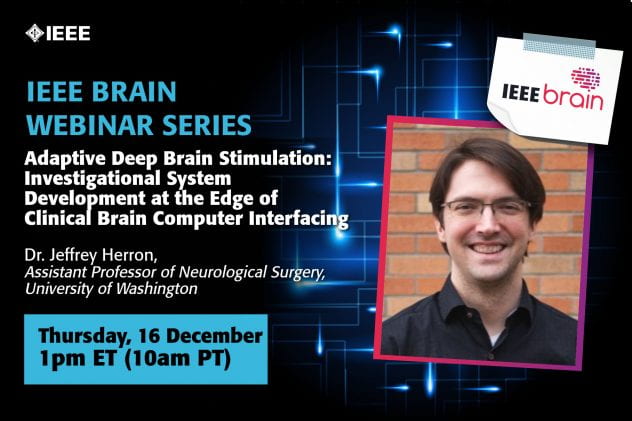
Presenting an IEEE Brain Webinar on Adaptive Deep Brain Stimulation

As part of the IEEE Brain Webinar Series I presented a talk on entitled “Adaptive Deep Brain Stimulation: Investigational System Development at the Edge of Clinical Brain Computer Interfacing” providing an overview on the development and latest research in the field of adaptive DBS.

The talk is freely available for the next month here, the talk abstract is below:
Over the last few decades, the use of deep brain stimulation (DBS) to improve the treatment of those with neurological movement disorders represents a critical success story in the development of invasive neurotechnology and the promise of brain-computer interfaces (BCI) to improve the lives of those suffering from incurable neurological disorders. In the last decade, investigational devices capable of recording and streaming neural activity from chronically implanted therapeutic electrodes has supercharged research into clinical applications of BCI, enabling in-human studies investigating the use of adaptive stimulation algorithms to further enhance therapeutic outcomes and improve future device performance. In this talk, Dr. Herron will review ongoing clinical research efforts in the field of adaptive DBS systems and algorithms. This will include an overview of DBS in current clinical practice, the development of bidirectional clinical-use research platforms, ongoing algorithm evaluation efforts, a discussion of current adoption barriers to be addressed in future work.

Ethics Collaboration focused on Closed-Loop Deep Brain Stimulation Systems detailed in UW #BeBoundless Article

A recent UW #BeBoundless article has publicized an ongoing collaboration with the Sara Goering, Eran Klein, and Tim Brown of the UW Department of Philosophy. This collaboration has been focused on the examination of potential ethical questions related to the development of closed-loop deep brain stimulation methods through interviews with patients enrolled in our ongoing feasibility study for improving the treatment of essential tremor. Check out the full article here.