“What does it mean to be a success on a dying planet?” “The future is looking back at us.” “Golden opportunities mask themselves as insurmountable problems.” –Kim Heacox
“The bigger the landscapes, the bigger you dream.” –Melanie Heacox
By Abby Weiler
We all woke up already exhausted. It was the morning after our first night sleeping in the house that Zach Brown graciously let us use and only two days after our wild sea-kayaking adventure. We hadn’t slept inside something other than a tent in well over a week so the warmth and the protection from wind and rain that a roof and walls provided was luxurious.
The day started with oatmeal and Shawna’s discussion about subsistence in relation to tourism. We discussed the impact of harvesting gull eggs in relation to Glacier Bay National Park. Professor Tim mentioned that “biologically speaking, we know that populations can sustain levels of harvest below a certain threshold; this is as true for taking seals, as it is for taking gull eggs.” Calvin observed that for many tourists, however, the harvesting of a gull egg is “less of an emotional whiplash” than seeing a seal being hunted. The conversation continued to discuss the laws as well as the morality of subsistence hunting in the park but also the importance of it to the Tlingit heritage. Incorporating subsistence practices for the Hoonah Tlingit’s back into Glacier Bay is a highly debatable question due to many factors including tourism, ecological impact, and honoring culture and tradition.

Lynn and George’s beautiful cabin.
Gustavus is a very small and friendly community so everyone in town knew we were there and they were all very excited to talk to us. Lynn and George Jensen, friends of Maddie’s grandparents, invited us to see the beautiful log cabin that Lynn had built when she was in her 20’s back in the 1970’s. During that time in Gustavus, grocery orders were placed once a year and people came together and placed orders for lumber to build their homes. Lynn didn’t order much lumber because she built her cabin from the trees that were once standing where the cabin is now. The life of the citizens in Gustavus is a very simple one. A lot of the residence grow and hunt their own food due to the expensive cost of groceries but also because they enjoy that lifestyle. Lynn and George don’t have a bathroom in their home, like many others in Gustavus, so they walk about 400 yards to an outhouse that George built.
After our visit with Lynn and George, we drove the van that our kayak guide service let us have for the weekend to visit with Tania Lewis, the bear biologist at Glacier Bay National Park and a great musician. During our drives around town we listened to Condor’s cassette collection in the van. He had anything from Simon and Garfunkel to Jon Denver.
We had met Tania at music night the previous evening and she invited us to her home to discuss subsistence and wildlife within Glacier Bay. We were welcomed with hot tea and delicious popcorn. We sat in the living room with her and her daughter while she recalled the first experimental harvest of gull eggs that happened roughly a year ago in the park. It’s something they are hoping to continue doing as gull eggs and subsistence hunting are essential aspects of the Tlingit culture. Sadly, we couldn’t stay long because we had plans to meet Kim and Melanie Heacox at their home for dinner. Kim has written many novels, including The Only Kayak and writes for the Washington Post. Melanie has been a park ranger her whole life and wouldn’t trade it for anything else. When she was just seven years old her family went on a trip to Yellowstone and she knew from that moment on being a ranger was what she wanted to do.

Discussion at Tania’s house
Just like every other home we visited that, theirs was just as beautiful and unique. We flooded into their cozy house and were met with so much warmth and delicious food. We sat around, while Kim asked us all to explain why we chose to go to UW and why we signed up for this class. We also shared our favorite stories from our time in Hoonah and from our time kayaking. Once we were finished reminiscing Kim told us that “stories are what holds us together, not atoms.” Melanie told us the first part of the story from the day the tribal house was unveiled in the park but became too overwhelmed with emotion and Kim had to finish the story. They mentioned how the walls of the tribal house “pulsed like a heartbeat” with all the people in the house dancing and playing music. This story was told to use from many people throughout the trip and the one thing that everyone mentioned about that day was how the walls moved like the tribal house was alive. While in Hoonah we listened to stories and in Bartlett Cove and Gustavus we heard them as well sometimes even the same story but told in different ways. Stories seemed to be an underlying theme of the trip. Everywhere we went we heard stories and told stories. All of us came on the trip as strangers but told stories of our life to learn about one another.
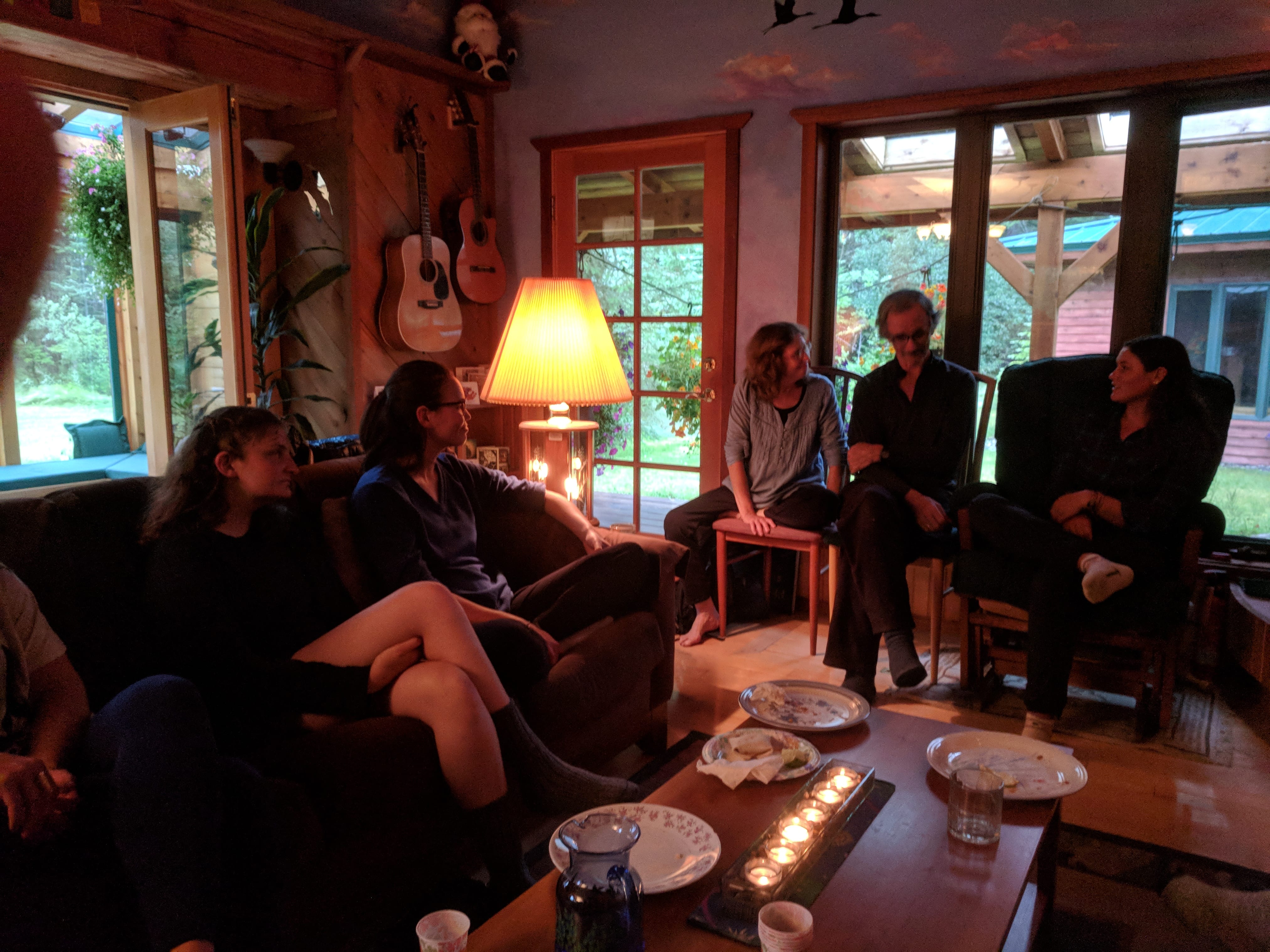
An evening with Kim and Melanie Heacox.
The two of them worked like a team. They were always feeding of each other’s energy telling us one story after another, asking us questions about our lives, and providing us with life advice. Many of us commented on how it felt like Christmas because of the strong sense of connection and abundance of food. When the conversations started to fade, Kim broke out his guitar and we all jumped in singing right along with him. The songs and laughter carried well into the night and before we knew it, it was midnight and we had to get on our way, so we could pack and prepare for a journey home the following day. All of us were heavy hearted as our night as well as our two weeks in Alaska reaching the end but also ready to get some well-deserved rest and sleep.
Reflection:
Prior to taking this course I was fairly naive to the conflict between Native American tribes and the National Park Service. Sitting in on discussions between representatives from the Hoonah Tlingit’s and Glacier Bay park service was astounding. Both are actively trying to create a strong relationship where the need of both entities are met. The compassion expressed in the relationship is something we don’t witness very often.
Not only did I learn academically but also spiritually. The trip to Alaska came to me at hectic time in my life. The clarity I found in the desolate wilderness of Glacier Bay was almost overwhelming. The life we lived for those two weeks was filled with so much but also so simple and relaxed. It reminded me to slow down and breathe in my everyday life. I gained what feels like a years worth of knowledge from only two weeks.