By Marco Ammatelli
July 31, 2018

“Pulling” in synchrony to the beat of a drum, across the bay in Hoonah (Jayna Milan)
Click here for brief video of our paddling excursion.
I wonder if Tim ate the rest of that cobbler?
Strange dreams.
When I awoke, overcast light penetrated the lone window in Yaakw Kahidi Cultural Center, dappling my sunburnt face and illuminating the leftovers on the counter from the night before. How could I possibly be hungry after all the fresh halibut, crab, and salmon head soup? Gently unzipping my sleeping bag, I emerged while others tossed and turned, their sleeping pads crinkling on the concrete floor. My ankles popped as I stood. With my camera in hand and a toothbrush in my breast pocket, I tip-toed toward the exit, wondering if brown bears still populated the streets of Hoonah during early morning hours. Slipping through a sliver of light, I turned to close the sliding wall of the shed, the wooden base grumbling as it rubbed the reinforced trim. In my peripheral vision, the gleam of a metal bowl topped with parchment caught my eye. Cornbread muffins. I’ll be back for you.
Outside, the air was moist. A silver mist hibernated in the hillside behind town, looming over homes designed for the South Pacific Theater but nevertheless diverted from Guam to Hoonah following the historic fire of 1944. Locals insulated the thin walls with newspaper to combat the cold, a necessity even in the summer months. By Alaska standards, however, this morning was mild. For half an hour or so, I welcomed solitude by walking the exposed beams of the marina, finding comfort in the slip of seaweed residue and the fragrance of low tide, knowing well the silence would not last.
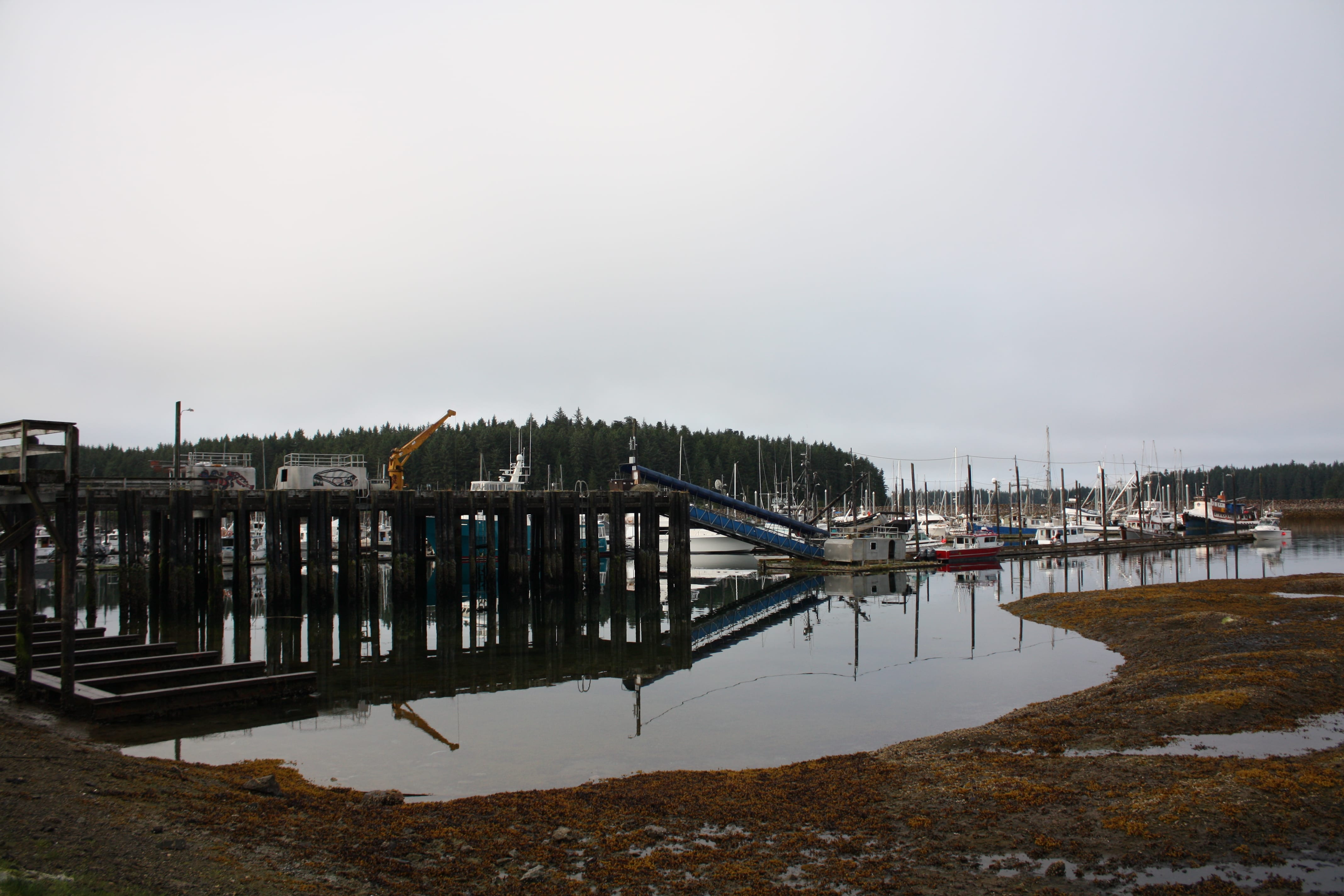
The Marina (Marco Ammatelli)

Summer Hibernation (Marco Ammatelli)
In the HIA conference room, we gathered for breakfast before a full day of presentations. Cream cheese and bagels, fry bread, a mountain of cornbread muffins, even fresh-baked oatmeal cookies graced the table, almost everything courtesy of our hosts. Passing the paper plates and plastic fork, we passed gratitude, the gift of simple pleasures. Overtime, eating eclipsed casual banter, and before long, a woman entered from the central offices, fabric folded in her hands and draped over her shoulders. Squares of black felt framed by red soon covered the head of the table, accompanied by a spool of white thread and a multitude of buttons, ivory in hue. One by one, she summoned us to sew buttons in congruent columns upon the blanket, asking for help with threading the needles under the dim fluorescent lights. “My old eyes,” she chuckled. Demonstrating the proper technique, she continued: “With each button, you are contributing to our history. Be gentle. Respect this artifact linking past and present.”
Passing the thread between my fingers and through the first hole of the button, the weight of responsibility pricked my conscience. This will be used to commemorate the healing pole later in August. During the final step, as I inserted the needle beneath repeating stitches, my apprehension grew. Common threads of history. I circled the protruding point three times and pulled. Pop! The thread snapped, my anchor knot simultaneously unseated. Tighter does not necessarily mean more secure. As I worked to amend my mistake—to ensure the button and my confidence did not become loose overtime—the woman, Jolene, placed a yellow pad on the table for us to write our names after we completed the task. “In the future, we will use this list to honor you as contributors, your willingness to share in our work,” she declared, pausing. “… As well as to verify who sewed the missing buttons.”
A wink punctuated her smile.

Mackenzie concentrates on maintaining alignment as she sews her button. (Tim Billo)
…

Can you imagine all of us fitting in one canoe? (Don Starbard)
On the edge of the dock near our vessel, the first fisherman of the day returned with a small catch, a father and son busy at the fish cleaning station. Subsistence practices are alive and well here, even if the methods have evolved. Under the late morning sun, my chest expanded and contracted like a steaming canoe, my black fleece a receptacle of heat constrained by the snug fit of a PFD. The urge to jump into the water was enormous, though erratic in nature. In the water, a massive dugout canoe nudged the dock where it wasn’t buffered by buoys. The brilliant red flanks showed no wear, the boat as strong as the people who carved it.
Sitting two across, we paddled into the open water of Port Frederick. While Zach commanded the bow, both Owens—Owen Oliver and Owen James of Hoonah—dictated the pace. Bambi steered from the stern, and Sherry ushered the boat forward with song and the beat of a drum. Avoiding the path of a landing floatplane and pushing against the tide, we angled for the cliffs between town and Icy Straight Point, the granite wall where fingers scrawled an images in blood-red many years ago. From the water, the faded petroglyph appeared more prominent than when we had viewed it from shore. This is the perspective of the artist. The storyteller. The rendering, two men and a wounded chief in a canoe, served as a reminder, a reminder of conflicted legacy, a reminder of battles won and lost. Turning away from the cliffs, a song echoed from the rear of the boat. One minute of singing seemed to span a generation. Not long after, Calvin dipped his iPhone beneath the water to capture strokes of penetrating sunlight illuminating bubbles released by the pull of synchronized paddles. The footage was mesmerizing, the view from below like a divulged secret, so much so the sea decided to steal it back. After one dip too many, the screen turned blank, black like a slate skipping stone, the device succumbing to an error in water-resistance. Both Tim and I peered over at the wounded chief. Battles won and battles lost.

Calvin contemplates the granite face–for the climbing or the petroglyph, I am not sure. (Tim Billo)
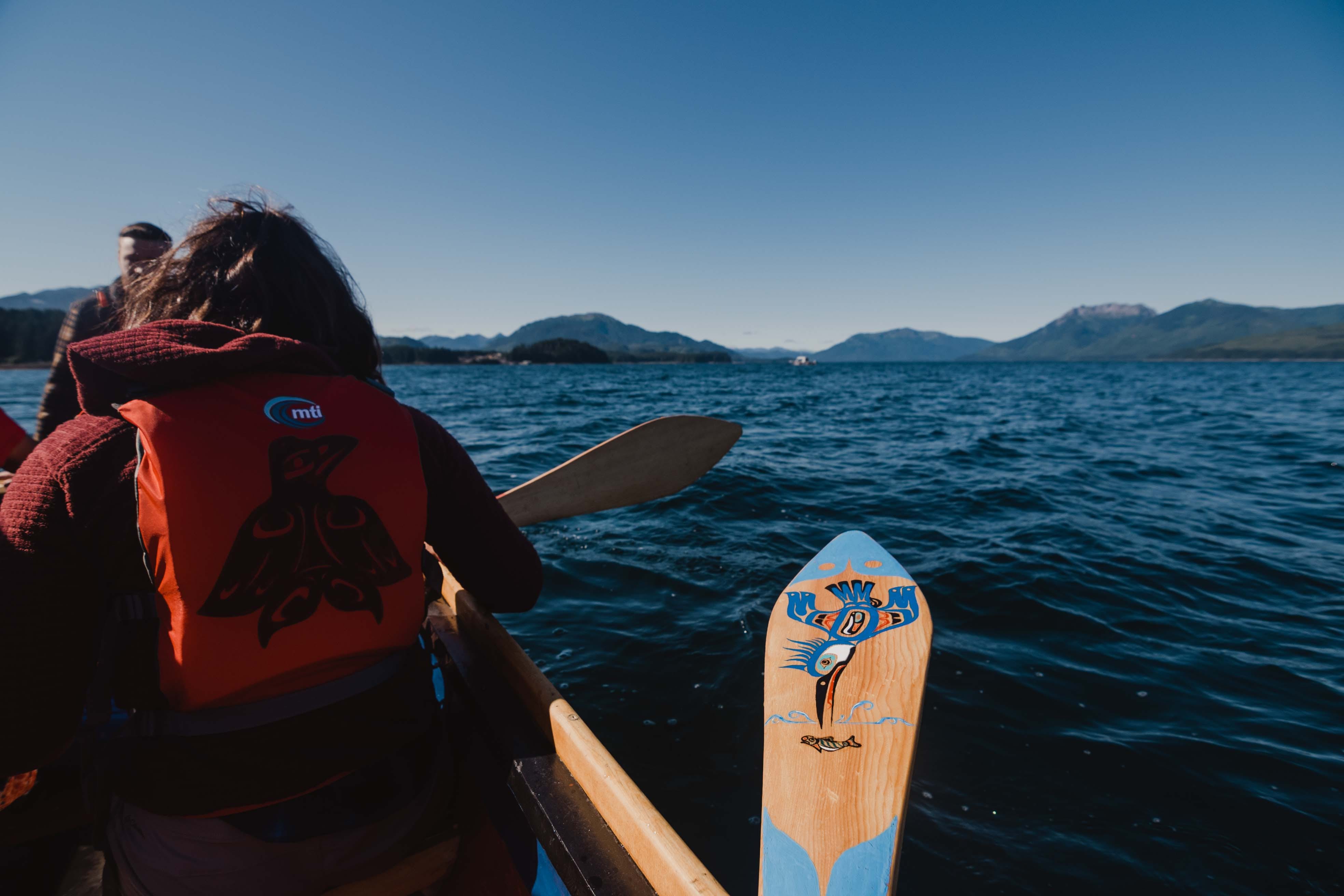
Formline Reintroduction (Jayna Milan)
Returning to the dock, we opted to test our coordination as a team. Speed. Sherry increased the tempo of the drumbeat, her chanting embodying rhythmic urgency. Mindful of the person in front of us, we dug in deep, pulling yet pushing, our hands grazing the surface of the water to submerge the entirety of the blade. The unified drive possessed an ancient resonance, a togetherness, a connection to the water unrecognized in the presence of motors. Indeed, each stroke of the paddle was a re-acquaintance—a reintroduction. Formline salmon painted on the blades merged with rippling waves and returned to the sea; diving herons flecked water from their wooden wings and returned to the sky with arching flight; a lone sea otter dragged its slender body at the surface, if only for one second at a time, before disappearing and popping up five feet ahead with cyclical repetition.
At that moment, I had no doubt of the spiritual significance of a canoe: a medium instilling sense of place across pathway geographies and generations, a shared art and a practical necessity, a living member of tradition.
A perpetuating gift.
…
Exhausted by our efforts, we let ourselves drift for a while before docking. Sea stars and small fish dotted the shallow bottom amidst floating pockets of green algae, some of which covered the buoy at my feet. Once Zach moored the boat, I dropped it overboard, pulling excess strands from my shoes as I stepped onto the aggregate walkway. Ascending the grated ramps back towards Harbor Way, I felt fulfilled—which was only half true, in retrospect.
The day was only half over.

Last on and last off: Bambi, the captain during our voyage. Her large steering paddle indicates her status as our skipper, and the form line artwork represents herself through her moiety (eagle), and her 3 eagle children (moiety is passed matrilineally). (Tim Billo)