By Tim Billo
July 30, 2018

Departing Juneau Auke Bay Ferry Terminal, under blue skies. The Mendenhall Glacier cascades down from the Juneau Icefield behind. Our first official class discussion, on the deck of the ferry. The ferry ride offered many learning opportunities.
Part 1: Juneau to Hoonah (Scroll down for Part 2, about our first day in Hoonah)
After months of anticipation, the course was finally beginning. A sunny sunrise (sunshine being unusual in this part of the world) greeted us as we sped north out of Juneau in a van towards the ferry terminal. I kept my eyes out for brown bears on the river delta draining the Mendenhall glacier, and counted untold numbers of Bald Eagles lining up to feast on salmon carcasses. The excitement of Alaska was palpable, as other tourists in the van eagerly shared their plans for the coming days. As is usually the case on the first day of field courses, my mind was racing through various checklists— but the main question on my mind was whether all of the students would show up at the appointed place and time. To my relief, within 20 minutes of arriving at the terminal, all the students showed up piecemeal in a variety of taxis, vans, and other transport, and soon we were all on the ferry.
Needless to say, in student terms, the “stoke” was high. We gathered a circle of deck chairs on the upper deck of the ferry and began a round of re-introductions, not having seen each other since a meeting in a windowless room in Seattle back in May. As the towering wall of spruce forest behind the terminal receded away from us, the spires of peaks above the Juneau Icefield came into view, and the immensity of the Mendhall Glacier spilling down from the icefield to near sea level, immediately became apparent. I reminded my students that while we could have flown to Gustavus, the Alaska Marine Highway System is part of the southeast Alaska experience, not to mention a more environmentally sustainable way to travel. Traveling by public ferry boat through Southeast’s fjords provides opportunity to appreciate and contemplate the power of the ice that so recently shaped this landscape in profound ways…and from which the landscape continues to recover. Passing Admirality Island, which has one of the densest populations of brown bears in the world, we pondered why brown bears and black bears for the most part don’t coexist on islands, and why some islands came to have only brown bears, and some only black bears; and why wolves usually don’t inhabit islands with brown bears, but do inhabit islands with black bears. As it turned out, we could have asked one of the experts on this subject and other biogeographical conundrums of southeast Alaska, Richard Carstensen, who happened to be on the ferry boat with us (the first of many “small world” encounters we would have on this trip). A short while later we observed a pod of orcas, and a surfacing minke whale. Entering Icy Strait from Lynn Canal, forestry clear cuts of various sizes and shapes came into view on the hillsides at the south end of the Chilkat Range. In my 20 year absence, I noted that the vegetation was beginning to grow back on these clearcuts, having been relatively freshly cut on my first visit. Thus, we were afforded opportunities to talk about the history and politics of logging in the Tongass National Forest, as a beginning to the resource management theme that ran through our course. After a brief de-boarding at Gustavus, formerly known as Strawberry Point, to botanize, bird watch, and munch on wild strawberries, we discussed glacial rebound of Gustavus’ coastal plain (which is rising out of the water at an astounding 1 inch per year, even as sea level rises too). We rushed back to the ferry and were soon off again to Hoonah, on the opposite side of Icy Strait. Gliding across calm waters, the glaciated peaks of the Fairweather Range stood out in stunning glory behind the boat, while shearwaters played over the waves west to Lemesurier Island. The Alaskan weather had been eerily kind to us so far.

The Fairweather Range, with 15,000 ft. Mt. Fairweather in the back right, as we motor across Icy Strait towards Hoonah.
Part 2: Hoonah
Our visit to Hoonah would prove to be the most important part of the course in many ways, and it was crucial on a number of levels that we visited Hoonah prior to visiting the national park. In my conversations with Bob Starbard, Tribal Administrator and CEO of the Hoonah Indian Association (HIA), prior to the course, he reminded me that the HIA is the federally recognized governing body of the Xunaa Kawoo (clans of the Huna Tlingit) and as such is the “sole entity that officially speaks to the nature and state of the relationship (past, present, and future) between the tribal community and the National Park Service.” To start our course anywhere else would have contradicted tribal protocol, and on some level would have sent a message of subtle subversion of the reconciliation we had come to study. Additionally, Bob was adamant that we gain a deeper understanding of the social, cultural, and psychological space of the Huna Tlingit people today, through actual in person interaction with the community, rather through the stories of tribal interpreters in the national park. Bob was wise to recognize this, especially since all of us were coming to this experience with pre-conceived ideas about the Huna Tlingit people and homeland, and many of those ideas were based in anthropological accounts of traditional Tlingit culture and history which we had read prior to the trip. I reminded my students to put aside their preconceptions, and to approach what we might experience in Hoonah with an open mind. Case in point: our first major item on the agenda for that afternoon, was a visit to Icy Strait Point (ISP), a multi-million dollar investment by Huna Totem (the ANCSA Corporation of Hoonah) to re-purpose Hoonah’s cannery to attract cruise ship visitors from around the world. Having done much reading about ANCSA and the effects of ANCSA corporations, both positive and negative, on indigenous peoples of Alaska, we were excited to take a first-hand look at ISP.

A cruise ship docks at Icy Strait Point, a multi-million dollar investment of Huna Totem. A nice stand of mature spruce/hemlock forest is right behind that cruise ship.
First, however, as the boat pulled within view of Hoonah, I struck up conversation with Dave See, one of the tribal elders from HIA, who happened to be on the boat with us. He and his partner were returning from one of two annual shopping trips to Juneau to stock up on staples from the Costco supermarket. As we bantered up on deck, he pointed out places along the coast that had names and special meaning to him—an island with a tree whose top was shaped by a mistletoe broom, a cove where he goes for salmon, and another for crab, and another for halibut, the mountain where he’d be going for deer when hunting season opened in a few days. I was struck by the similarity to what the anthropologist Thomas Thornton refers to as Tlingit “path geographies” in his book Being and Place Among the Tlingit. While the book often unintentionally portrays Tlingit culture in a historical context, this conversation, and many others I would have later, made me realize how important “path geographies” and subsistence are to the Tlingit today, or to what Thornton calls the Tlingit “sense of being,” in quoting a tribal fisherman Gabriel George. These are not memories of lives gone by, or cultures of the past—rather they represent much of the continuing present reality of the Tlingit, even as hunting and fishing techniques change, and/or other aspects of their culture change as the world changes around them. The key message that was driven home to me on Day 1, was that it is expensive, impractical, and unsustainable to travel to Juneau to shop more than twice a year. It is even more expensive to shop in the small grocery story in Hoonah. It is a given, according to Dave, that every Friday after work, you’ll be gearing up your boat, or your pickup truck, for travel over a long weekend out to your favorite spots for hunting and gathering. It is a given that you will share what you catch with your family and friends—and Dave took great pride in not only supporting his immediate family’s nutritional needs, but that of his many grand children and their families. With year-round employment in Hoonah scarce, super markets expensive and/or far away, subsistence fills a very a practical need, both from the standpoint of immediate survival, as well as living sustainably in a remote location. The cultural benefits of subsistence through connection to food, landscape, and extended family are crucial too, and to some extent subsistence is what enables the critical parts of Tlingit culture to persist and be passed on naturally. Here then, I began to get a feel for the deep cultural importance to the Huna Tlingit of exercising their sovereign rights to subsistence practices in their traditional homeland within the boundaries of Glacier Bay National Park. This was about “sense of being.”
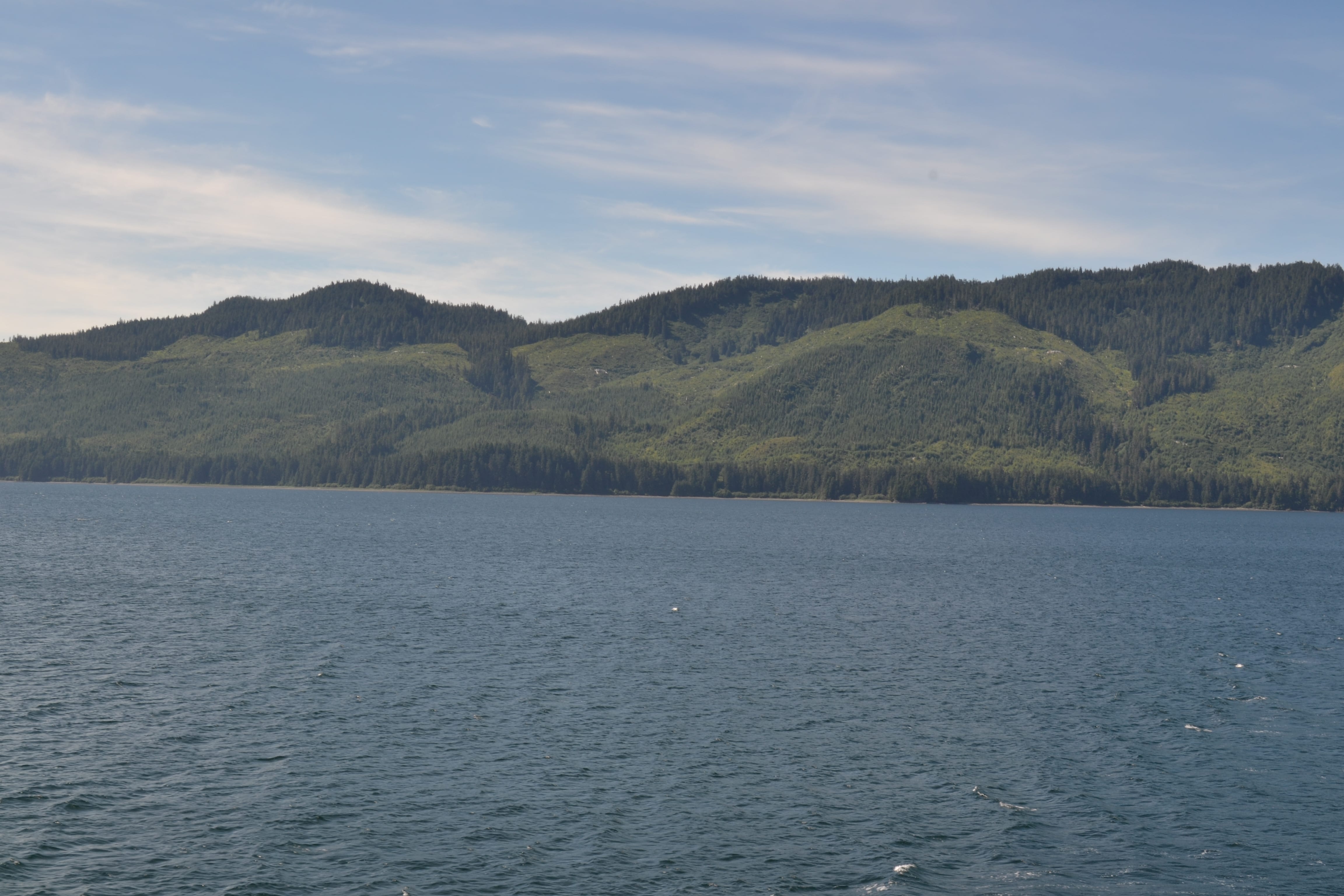
USFS, Sealaska, and Huna Totem logged much of Chichagof Island up until the 1990s, when the logging industry went bust. There wasn’t much merchantable timber left to log, and even stands such as this one, right across the bay from the village, ultimately were cut (despite original intent not to). Jobs were lost and Huna Totem was forced to go through a time of reinvention, in order to continue delivering on its mandate of profits to shareholders.
We were met on the dock by Zach Inglesby, a summer intern with the HIA, whose grandfather was Huna Tlingit, but whose children (one of Zach’s parents) had left Alaska for Washington and Arizona. As Zach sought to reconnect with his grandfather’s culture, he had been adopted into the Hoonah community and Tlingit tribe. The friendly, almost ruthless, ribbing he took at every turn, mostly from male tribal elders, was indicative of his outsider status, but also of his gradual induction into their community. Zach led our tour of Icy Strait Point. We walked out to the new dock where a cruise ship was tied up. As a business aficionado himself, he went through the details of the upfront investments, loans, past and projected profit margins, and past and projected dividends to shareholders (mostly Hoonah residents and their children scattered far and wide). Huna Totem was the village corporation established by and for Hoonah, under ANCSA. After logging nearly every parcel of merchantable timber (maximization of profit being a requisite of public corporations) given to them in the 1980s and 90s, the Huna Totem logging industry went belly up. While profits were re-invested in real estate, often if far away places in the lower 48, the logging of Chichagof Island came at a high price ecologically, economically, and spiritually to the Hoonah people. Tribal Administrator, Bob Starbard literally cried upon his return to Hoonah after more than 10 years away during the logging boom. Codes of ethics on which particular timber tracts (especially those around town) would be off-limits for spiritual reasons, were broken. Stream buffers were largely ignored or shrunken, and some salmon runs became critically endangered (see Owen Oliver’s post about HNFP on this blog). Deer lost critical winter shelter and browse as interlocking canopies were lost all over the island.
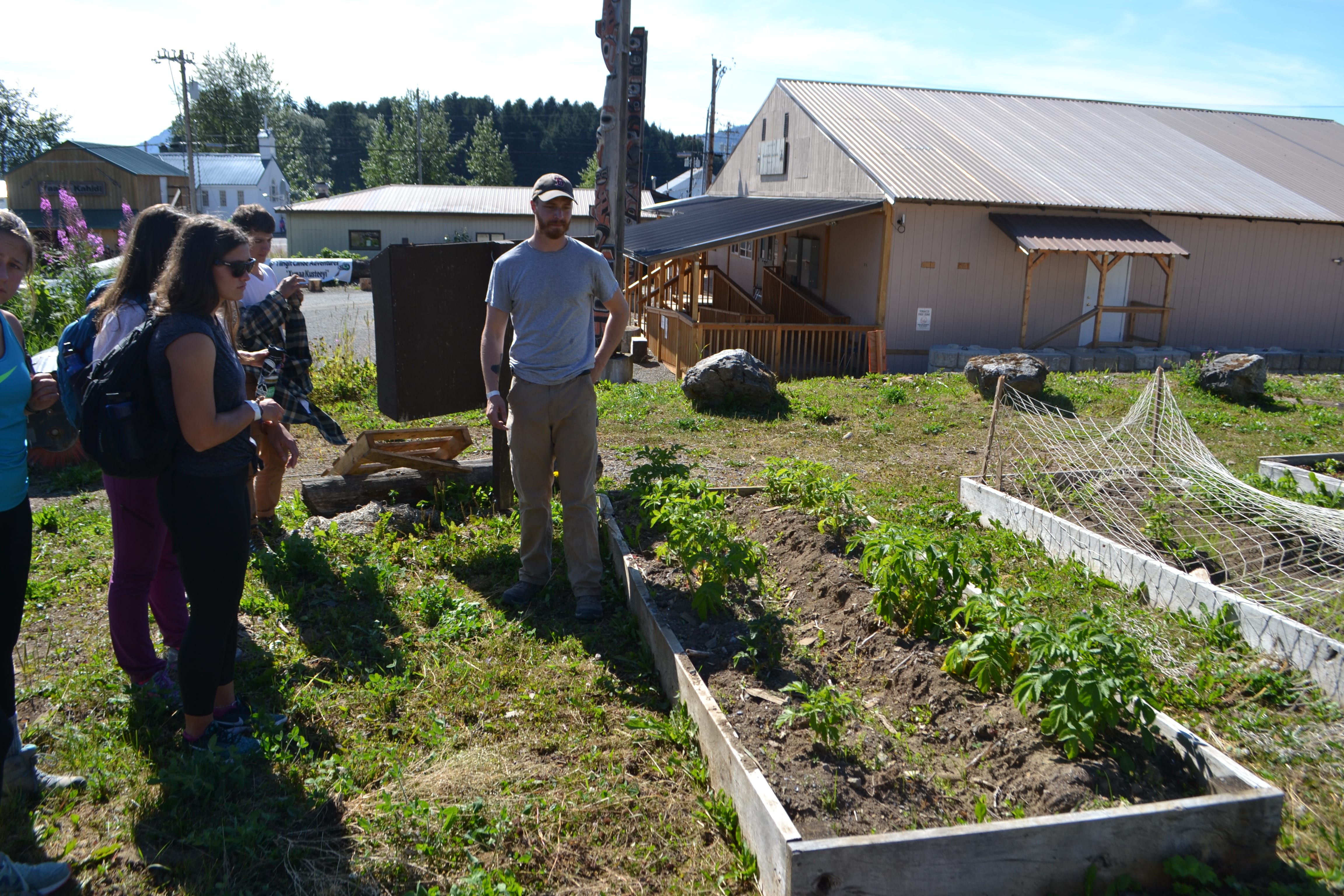
Zach talks about the community garden plots behind the cultural center. Lots of rain and long days make vegetable gardening a viable and economical way to fill nutritional needs.
But the new Icy Strait Point represents a fresh start for Huna Totem. Re-purposing a defunct cannery with large loans from the cruise ship industry at questionable interest rates, might represent a sustainable source of income for the community into the future. The jury is still out on this, but once loans are paid off at some point in the coming years, Hoonah residents should expect to see bigger dividends. Indeed dividends, although small, are being paid out again this year after falling off for some time. The cruise ship dock and old cannery are about a mile from the Hoonah village. The shiny, renovated buildings, boutique stores, and eateries were tastefully done, but in stark contrast to the relatively impoverished community of Hoonah, living in houses that were slapped together after the great Hoonah fire of 1944, a mile down the shoreline. Most visitors to ISP chose to partake in the world’s longest zipline, from the summit of a culturally important peak, down to a bar at Duck Point, another place of cultural importance to the Huna Tlingit, where they could then buy a shot of alcohol and a T-Shirt commemorating their experience (or maybe the alcohol came first, I’m not sure). Many of us were conflicted by what to make of all of this, as we walked the shoreline to the village (which is trying to implement a tobacco and alcohol free policy), past an ancient petroglyph telling stories of the ancestors. WE had hoped to meet with Huna Totem executives during our time in Hoonah, but they were not available.
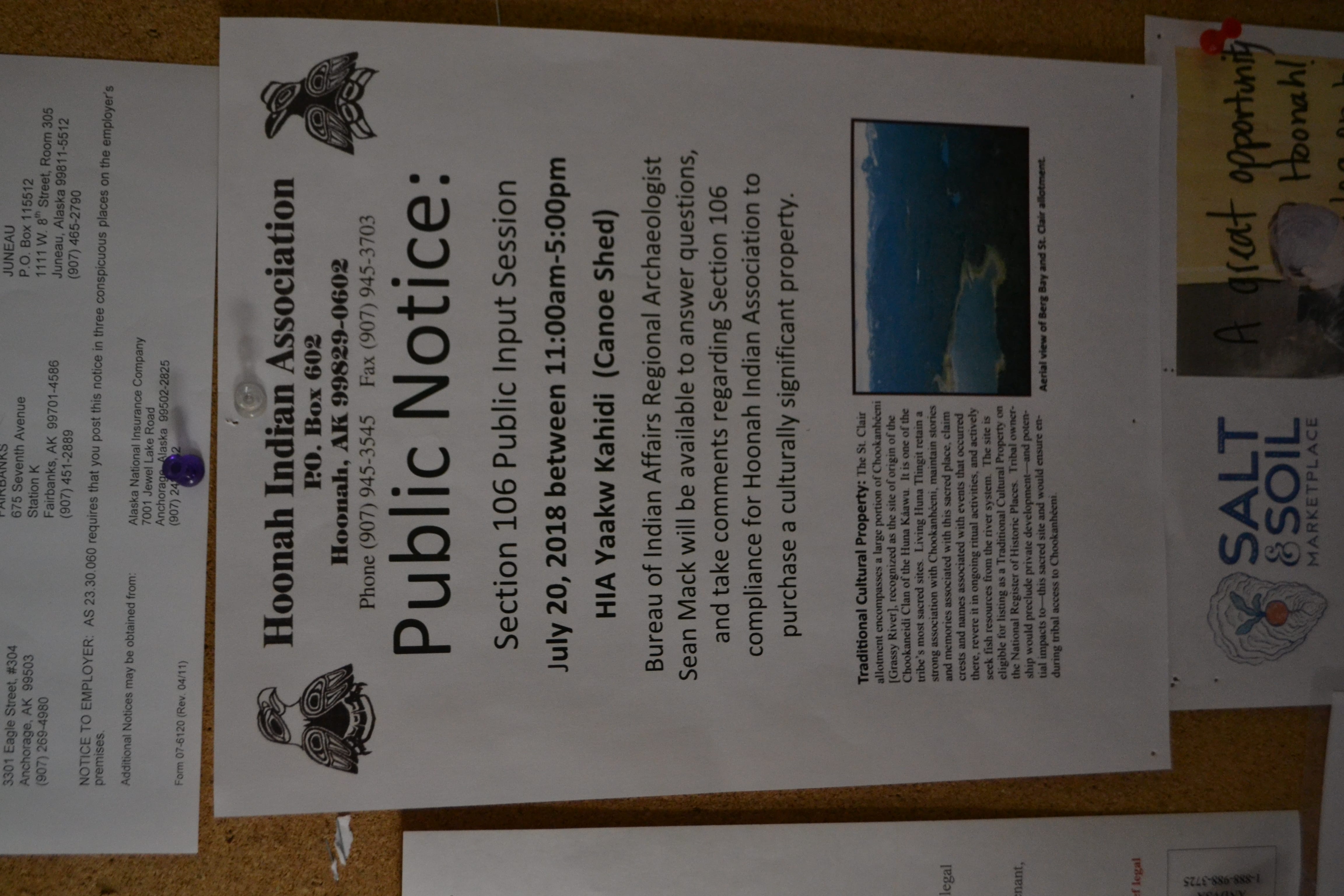
HIA proposes to buy a “culturally significant property” within Glacier Bay, the site of origin of the Chookanheeni Clan, thus securing actual property rights within the national park. The purpose of the purchase would be in part to exercise symbolic sovereignty over land in the bay, but also to put a conservation easement on the property in recognition of solidarity with the mission of the NPS. NPS is helping to facilitate the transaction.
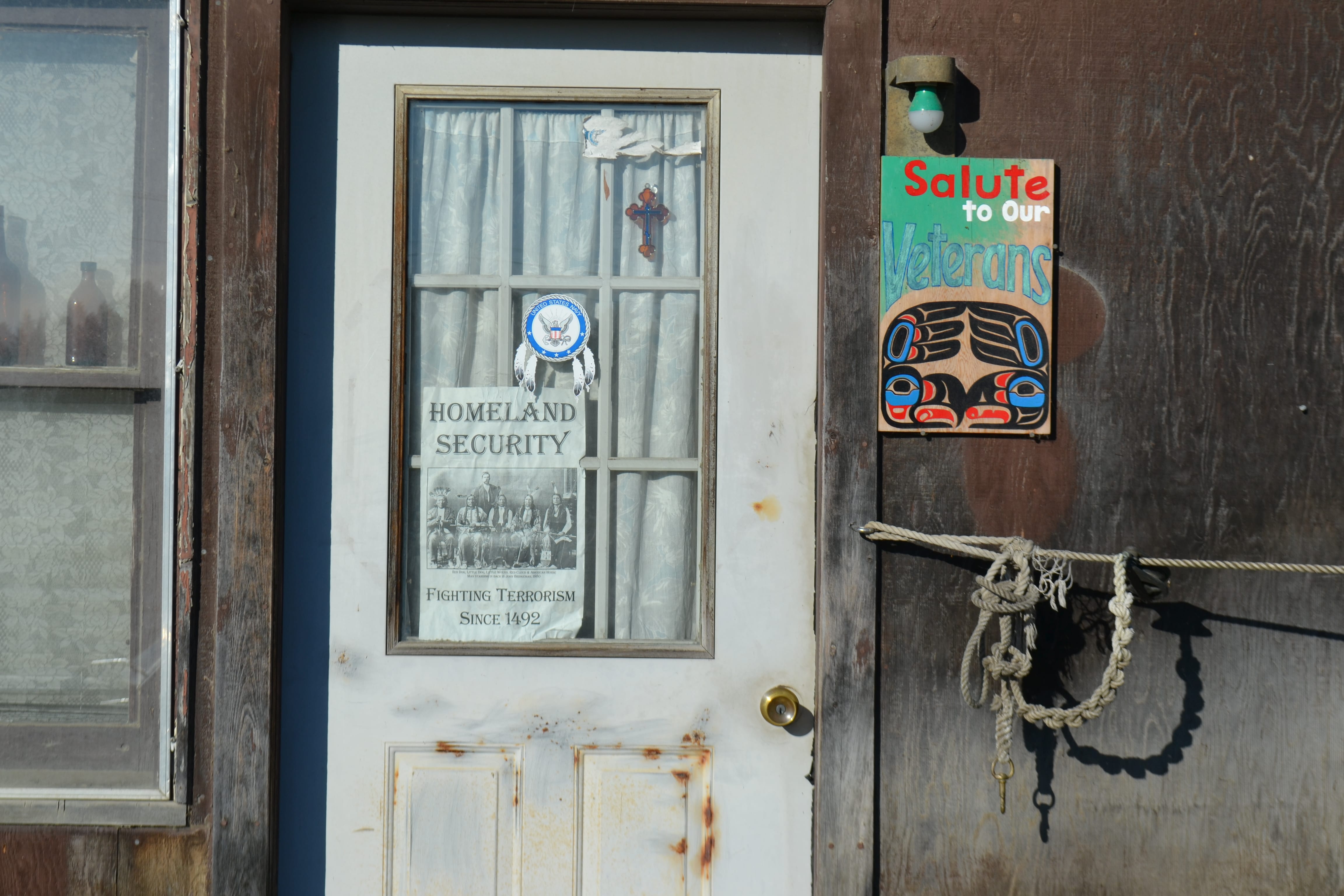
House along main street in Hoonah.
Those relatively few tourists who elected to travel to the village rather than remaining at ISP or heading directly to the zipline summit, were greeted by an authentic, low-key, and friendly small-town experience in Hoonah. Regular townspeople worked tirelessly to staff the Yaakw Kahidi cultural center to make these out of town folks (such as ourselves) feel at home, respectfully answering all manner of clueless but usually well-meaning questions, and proudly sharing many aspects of their culture. In particular, we and the few tourists around us, were especially curious about a number of totem poles in the carving process. We were quickly led to, and gathered around the pole that really symbolized the whole purpose of this class: The healing pole that would be raised in Glacier Bay National Park on August 25th, 2018 (see video later in the blog). Tribal elder and carver, Owen James, started at the bottom of the pole, explaining that the Tlingit story telling tradition starts in the past and moves to the present, leaving open the future for speculation and opportunities for future storytellers. He noted that other cultures start in the present and move to the past, or write the story down and put it in a book with a front and back cover. At the base of the pole were depicted objects of cultural importance, such as the leaves of the Devil’s club, one of the most important medicinal plants to the Tlingit, followed by a glacier overcoming the Tlingit village in Bartlett Cove, some 500 years ago, and chasing Tlingit pullers (paddlers) as it approached. After that, an eye-less being with many arms, and holding a literal chain with a padlock, bolted to the pole, depicted the many arms of the federal government, blind to the past and to the culture of the Tlingits, effectively cordoning off the Huna Tlingit from access to their homeland. The top of the pole featured figures in the traditional hats of the national park service and the cedar hat of the Huna Tlingit, similar to the one worn by Owen himself, which was also adorned with the pelt of an ermine, depicting a new reconciliation over issues of cultural and subsistence access to Glacier Bay, and shared protection of the landscape. The pole would be raised a few weeks later, sadly after the end of our course, in Bartlett Cove in Glacier Bay, followed by ceremonial speeches and dancing in Xunaa Shuka Hit.
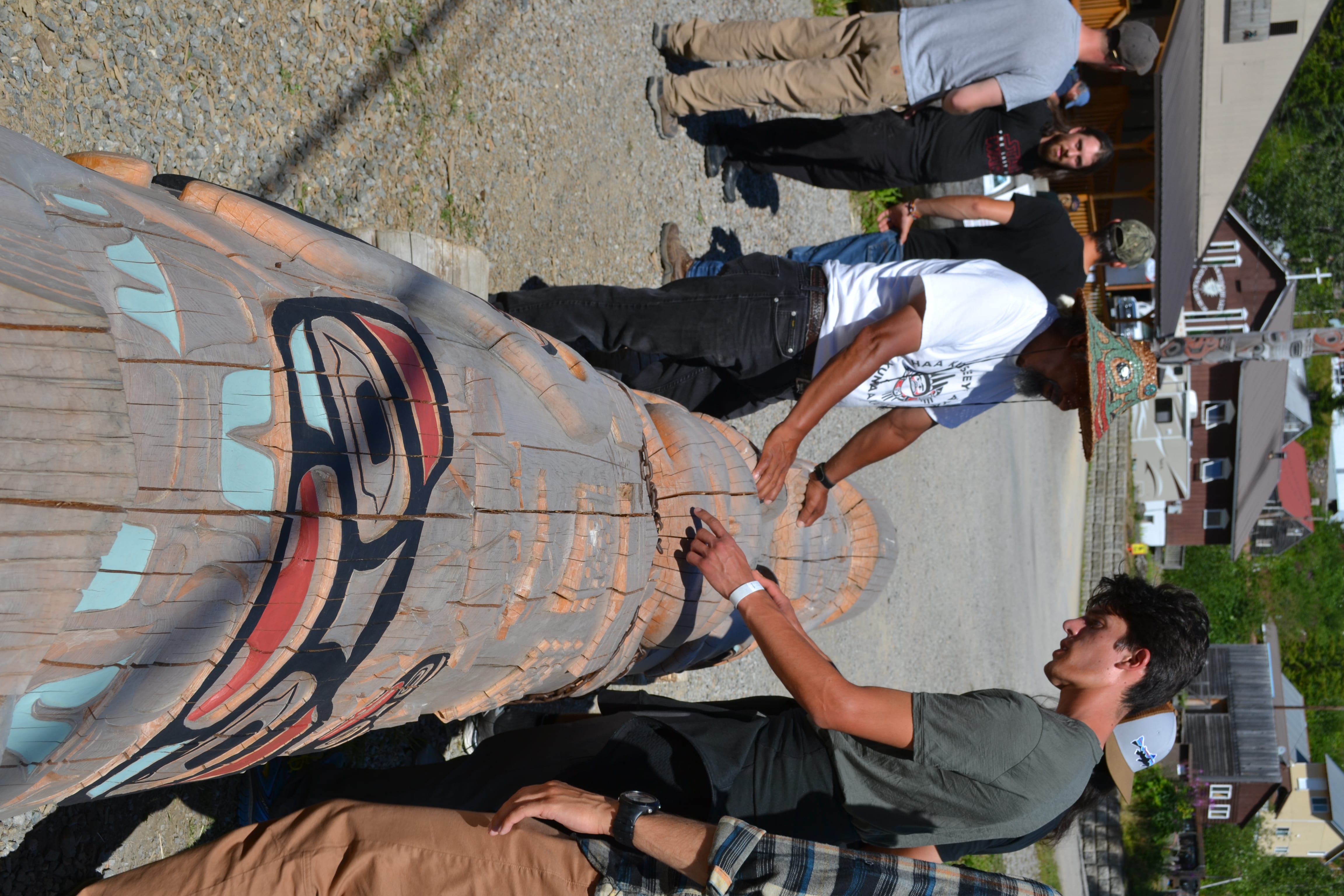
Owen James, master carver, explains the story on the healing pole, while Marco Ammatelli examines the designs.

One of the most unique features of the healing pole was a blind person with many hands, and a padlocked chain. Uncharacteristic of the many traditional elements you would expect to find on a totem pole, this feature represents the many arms of the U.S. government, which is often blind to the needs and history of native people, and the symbolic “locking out” of the Huna Tlingit from their homeland.
Later we walked to the carving shed where Gordon Greenwald, master carver and mastermind of the story panels in Xunaa Shuka Hit, was working on another pole, privately commissioned, with carver Herb Sheakley. Gordon explained his career teaching woodshop and carving at the local school, and his desire to gift the carving tradition and the stories told in poles and house panels, to future generations. His T-shirt, with the words: “In 1492, Native Americans discovered Columbus Lost at Sea” belied his sense of humor and pride in his culture. He showed us his hand-made carving tools—in particular, an adze made from the hammered leaf springs of an old pickup truck, mounted on a hand-carved alder wood handle. He let us all take turns shaving wood off the top of the pole he was working on with Herb, and explained how each person who works on a pole adds a bit of their personality into it. An experienced carver can tell right away which parts of a pole were carved by whom.

Master carver, Gordon Greenwald, shows off the adze he made from the leaf springs of a truck and a hard-carved alder branch.

Herb Sheakley at work on another pole.
That evening (hard to imagine we are still on Day 1!) we were treated to a community ku.eex, or potlatch style dinner and ceremony at Yaakw Kahidi. Community young and old gathered with delicious homemade dishes to share, many using traditional food resources. Halibut prepared in two different ways, Dungeness Crab legs, salmon head soup, cherry pie (with cherries from a tree in someone’s yard) were just some of the many dishes we feasted on. Prior to dinner, Bill Wilson, tribal elder gave a convocation in Tlingit, giving thanks and wishing us well on our journey of learning in the Tlingit homeland. I had a chance to sit with Bill at dinner to learn about his childhood, and how, as a member of the generation that had had Tlingit culture and language forcefully repressed by BIA schools, he managed to retain his native Tlingit. Among his siblings, he was sent to live with and take care of his grandparents, who only spoke Tlingit. He became a defacto interpretor for them, and it was accepted by the community and powers that be at the school, that he would speak Tlingit as a matter of caring for his grandparents.

Experiencing a ku.eex or potlatch. Fish head soup (foreground) was one of the many traditional dishes we tasted that evening. (Photo by Jayna Milan).
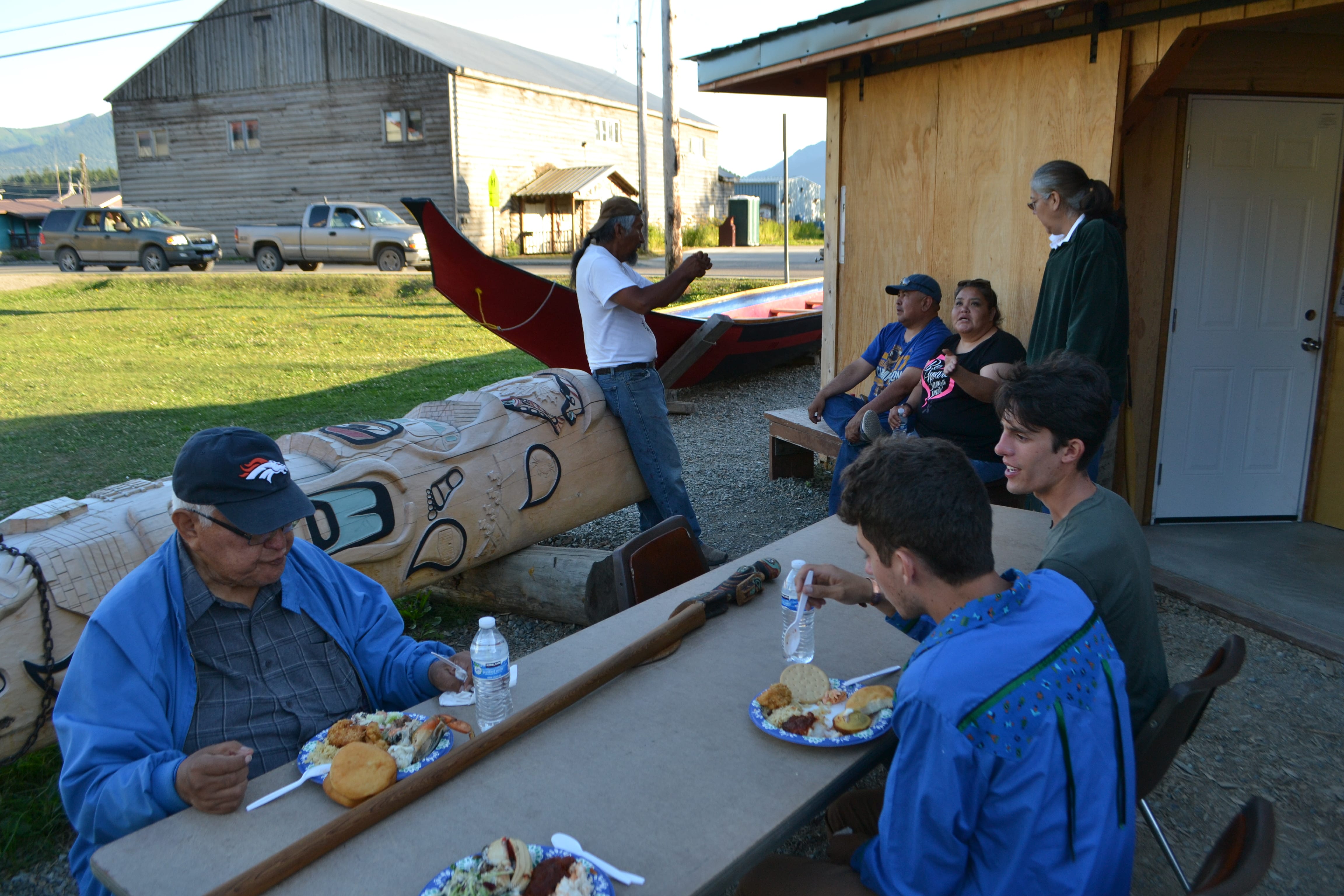
Marco and Calvin chat with Bill Wilson over dinner. Owen James (background) later taught me the proper way to eat a salmon head.
Bill would later that evening, staff in hand, tell stories in his native tongue, and lead the community members in group song and dance. Hearing Tlingit spoken by a native speaker of the language was for me one of the most powerful moments of the trip. While it is simply beautiful to listen to, language for me is the most powerful form of culture. Its words and grammar reflect social and geographical tradition. Place names and family names, species names, relationships to the land and resources, are all reflected in language, especially in indigenous languages that are so deeply tied to place. Once language is lost, essential elements of culture can be lost or diluted too. Indigenous place names and species names often imply or imbue deep meanings or understanding of those places and species, including how and when the species were used. The impact of suppression of language and community gatherings (ku.eex) was, sadly, I’m sure not lost on the policy makers within the BIA. Hearing Bill speak and tell the traditional stories of place, was like listening to the voices of the ancestors, reaching back into an ancient cultural memory, and pulling it into the future. Reminding us that the Tlingit culture, like so many Native American cultures, is alive and resistant to whatever short-term setbacks it may have suffered. The tenacity it took to survive in these sometimes cold and desolate landscapes is what has carried this ancient culture forward through challenging times, and why it is not going away. The Tlingit people hold a long view—they understand the arc of time and deep connection to a landscape in a way that cannot be understood by the National Park Service and more recently colonizing forces.
Click here to hear part of Bill’s invocation.
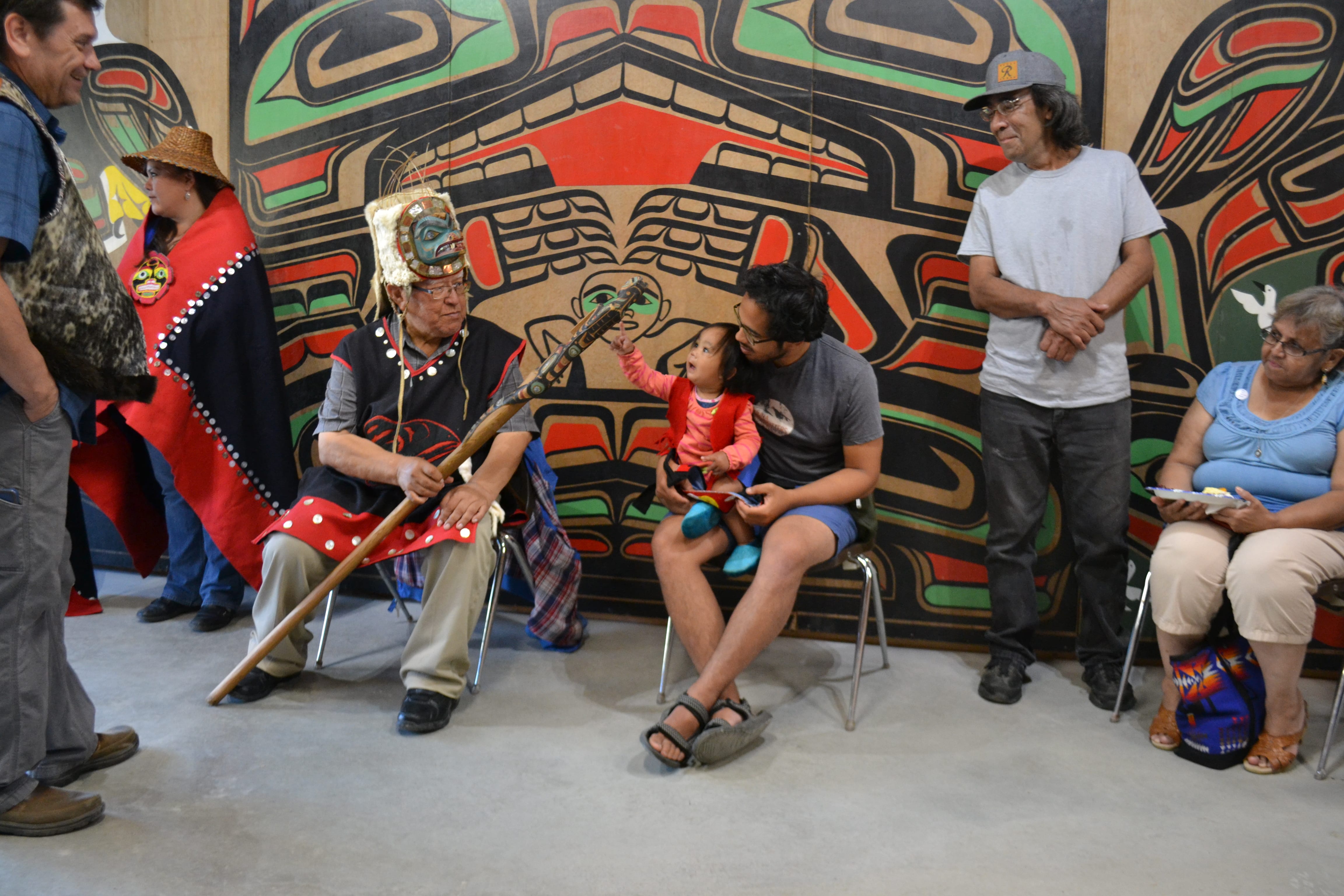
Miguel and his daughter examine Bill’s staff. Bob Starbard looks on, left.