Alternative Milk, Our Earth, and Systems Theory

I really valued what I took away from this course, as it presented new and challenging topics that I had never considered before. It also gave me the opportunity to conduct research on a topic I took a great interest in: the sustainability of alternative milk products. I was inspired by a previous blog post I wrote, about a climate change food calculator that calculates the ghg emissions, water usage, and land usage of 40 different foods.

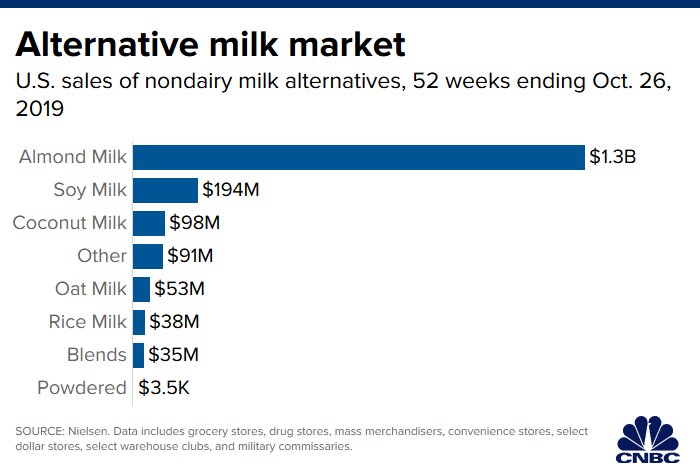
With the massive changes in the dairy and alternative milk market, I decided to use this as a jumping point to look into three milk products: milk from dairy cows, almond milk, and oat milk. I researched and compared all three products with reference to water usage and GHG emissions. I was mostly interested in determining if alternative milks were actually more sustainable, and if so which was the most sustainable milk?
I looked closely at the sections about food systems and the effect of climate change. I determined that the ecological system and the food production system are incredibly intertwined and interdependent. The ecological and biological systems greatly affect how food is grown and produced, and the food production system has had very adverse effects on the environment.

My research only scratched the surface of sustainable food production practices, but it is a critical piece in the future of food production. This course gave me a deeper understanding of systems theory that allowed me to analyze a topic in a more meaningful way.

Works Cited:

Guibourg, C., & Briggs, H. (2019, August 09). Climate change food calculator: What’s your diet’s carbon footprint? Retrieved June 09, 2020, from https://www.bbc.com/news/science-environment-46459714

Image:

Lucas, A. (2019, November 13). 5 charts that show how milk sales changed and made it tough for Dean Foods to avert bankruptcy. Retrieved June 09, 2020, from https://www.cnbc.com/2019/11/13/5-charts-that-show-how-milk-sales-have-changed.html

Women’s Land Rights and the Pandemic

For our action project, we worked with Landesa. We focused our efforts on connecting the current pandemic to the role of women’s land rights and food security in Sub-Saharan Africa. We concentrated on this region, as it has faced the epidemics of HIV/AIDS and Ebola, and has had to overcome these crises while dealing with the ongoing natural problems that are endemic to the climate and region (drought and political instability). Additionally, the region has long-suffered from exploitation and pressures of global imbalances of power. What has become evident, is that developed countries are able to leverage local resources, which are developed and cultivated by African nations to advance their own stability and serve as a source of resilience. Against this backdrop, the region will continue to evolve as “an arena of geopolitical and resource competition…” and this can be problematic, as Africa may be disenfranchised from ‘solutions’ that are developed within the region. This is where the role of women’s land rights becomes a driver of law and policy reform and economic self-reliance and community leadership. Allowing women to have direct and impactful roles in the food system will foster a resistive and durable base that the communities of Africa can count on for stability and lean on in times of crises.

An infographic created for our Landesa Project (Graphic by Ashley Wright)

What I have recognized in Landesa is that many of the defining attributes and workings of systems theory are functioning through this organization and the work it is doing to make an impact on society. We were able to connect seemingly individual and distinct topics into an aggregate context relevant to human systems and, by extension, the ecosystem. (from lecture) What is common across developed, developing, emerging, and underdeveloped economies is growth. This trend towards an improved standard of living does not emerge in isolation. In this case, women’s land rights connect to all of us, even if we benefit indirectly. Through a woman’s ability to own and control land in Africa, the role of my country (or another developed country) will shift as it benefits from concurrent growth. And this shift can impact my community whether it is through the flow of money or access to food as a whole. We all benefit from socio-political stability, as instability can result in a misallocation of resources. Currently the IMF projects negative growth for the region through this year, but forecasts a return to positive growth through 2021.

Raisins Throughout History; a Contemplative Practice

The main goal of the contemplative practice on raisins was to look introspectively at the modern processing of foods. When participating in the practice, however, I felt drawn in another direction. My mind kept wondering to ancient fields. It is believed, according to California Raisins among other sources, that the Phoenicians were the first to produce raisins. What I pictured during this practice was happy workers with beautiful sunsets over Mediterranean vineyards. The reality would likely have been much different.

Just like today, exploited workers likely would have worked long hours to produce raisins that, according to Sun-Maid, were frequently prized possessions of the wealthy across many civilizations throughout history. While the raisin is a relatively cheap commodity today, it represents a trend in agrarian history. Land largely held by the wealthy is worked by laborers, often too poor to afford the food they are producing, to make something the wealthy will enjoy. This was likely the case for many civilizations in which grapes were produced and is certainly the case for much of the fresh produce grown in America today. The raisin may bring a sweet smile to its eater but is a powerful symbol of the agrarian system that has remained relatively constant throughout time.

This contemplative practice was successful in engaging me in a new way of thinking about my food. I made links to a raisin that I otherwise would never have seen. I think that I took the exercise in a different than intended direction but I enjoyed the path it led me down.


Work cited

“History of Raisins and Dried Fruit.” Healthy Living, Sun-Maid, sunmaid.jp/healthyliving/history_of_raisins_and_dried_fruit_English.html.

“History.” The California Raisin Industry, California Raisins, calraisins.org/about/the-raisin-industry/history/.

Like a Tree

Before taking this course, the idea of a structured time to practice meditation ‘in’ the classroom was not something that I had experienced before. As I learned more about the history and uses of contemplative practices, the image of a tree was common in describing its structure. This image had a profound effect on me as it illustrated and enhanced the benefit of these practices and just how multi-faceted it is. Like a tree, we are ever growing and are grounded in our core ideals and beliefs. The role of the contemplative practices allows us to further grow our tree and trim it in places or take it in a different direction – one that is built out of a changed and fuller frame of mind.

Image Source: http://www.artchangeseverything.org/2016/09/the-tree-of-contemplative-practices_3.html

The contemplative practice that has stood out the most to me is the one on feeling hunger. This practice further illuminated the privilege that I hold in my relationship with food and the ability to consume and benefit from food on my own terms. As we have learned, the current food system is made up with the goal of making money, not food. And even though we have the food necessary to feed the population of the world, this is not happening in part due to aesthetic standards and amount of food required to feed livestock. An article from the Guardian illustrates the relationship between changing our diets and the ability to be able to more greatly feed and serve the whole population of the planet. When addressing your own hunger, it is becoming pivotal to understand how you are filling it and the impact that it has on the environment and fellow inhabitants of the world. While a massive structured change is necessary, knowing your role in the food system will help change it.

The Privilege in Contemplating Chocolate

Contemplating chocolate before eating it seems like something quite odd to do, however it is important to take the time to consider the implications of our eating and in the words of Michal Pollan, consider how eating is a political act.

During my contemplative practice, I was struck mostly by the video about cacao farmer N’Da Alphonse in Ivory Coast, and his first ever taste of a chocolate bar. The reality – both convicting and surprising – that the man who grows the cocoa which is eaten all around the world as chocolate has never had the privilege of tasting his own product. I felt disturbed, confused, and frustrated thinking about the injustice that surrounds the growth and sales of chocolate. I also thought about globalization (which we often discuss in this class) and as depicted in the image below, how the system has ravaged many developing populations for the cost-benefit of first-world nations.

One of the ways in which globalization has impacted the world is in the centralized purchase of goods that settle for low prices, high efficiency, and large profits. This has resulted in what we call global capitalism, which is exemplified in the fact that 147 of the world’s corporations and investment groups controlled 40 percent of corporate wealth, and just over 700 control nearly all of it (80 percent). This corrupt version of capitalism monopolizes power and resources, often leaving farmers in developing countries behind with scathingly low pay, unsafe working conditions, long hours, and abusive child labor. In fact, around two million children work in dangerous conditions unpaid on cocoa plantations in West Africa. This brings into light even more the injustice and lack of food sovereignty that the global commodity food chain has created for the majority of developing countries around the world.


Sources:

https://www.youtube.com/watch?v=zEN4hcZutO0 https://www.cornucopia.org/2008/11/michael-pollan-eating-is-a-political-act/ https://www.thoughtco.com/why-is-global-capitalism-bad-3026085 https://www.thoughtco.com/all-about-the-global-chocolate-industry-3026238


“Essential Workers”: Heroes or a Sacrifice to Capitalism ?

In the face of major shifts and/or unrest both global and domestic, the US has historically relied on the most marginalized groups to uphold the status quo; an aspect of our history that is too often left out of, or skewed within, popular narratives. An example ringing with familiarity, was the onset of WWII (when swaths of the agricultural labor force migrated into war production factories) the 1942 Mexican Farm Labor Program Act systematically promoted the exploitation of immigrant labor as a means to keep meeting food demands on the backs of “cheap” labor. Our immigrant workers are a labor force that has been consistently condemned, ridiculed, and cast out. And again, today, in the face of a global pandemic, we are turning to the numerous undocumented immigrants that make up our 2.4 million farmworkers to continue to supply us with our demands (Honig, 2020). They are essential to keeping America fed.

Yet, as the choir of bells ring through our cities in gratitude to those who are on the front lines, these essential workers continue to work unprotected in close quarters, high risk conditions, and extremely limited access to testing or health care. And when calls are made to solve these issues, and to provide adequate provisioning, they are too often being met with no answer. Ultimately, they are being ignored. Still though, the faces of leadership turn to the media to give praise and show appreciation of our essential workers… our “heroes.”

Is this the way to treat our heroes? Do we truly believe that these people put themselves at risk everyday, in-spite of the love of their families and own lives, to be our “heroes?” Or have they been given no other choice, no other option to sustain themselves, or their families? And, in knowing this well, the faces of leadership can chose to tend to their need or not. The migrant workers, who have always been an essential labor force, are treated as if they are disposable. This pandemic is not an independent actor, it is constantly being fed by the conditions that were already established, long before it’s outbreak. Vulnerable living conditions, limited access to health care, muted voices, and insufficient ground to establish self-determination are the by-products of our capitalist structure that continues to sustain itself through the most marginalized people, who tend to fill our most essential positions.


This blog post was inspired by the FERN article: https://thefern.org/2020/04/as-pandemic-spreads-and-growing-season-ramps-up-farmworkers-deemed-essential-but-still-largely-unprotected/

Food Supply Chain “Strong” But Questions Remain

Washington State Governor Jay Inslee declared a statewide shutdown of restaurants and other public spaces back on March 15th, assuring Washingtonians that the supply chain was strong, hoping to alleviate fears and hoarding by consumers. And while grocery stores have remained open, albeit with sparsely stocked hand soap and toilet paper shelves, an NPR article released a few days later raised questions about the trying times about to strike those in a different—yet equally vital—part of the supply chain: agricultural workers.

Workers in Wapato, WA. Photo Credit: Elaine Thompson/AP

The good news is that most seasonal workers coming from Mexico will still qualify for their H-2A visas. The bad news is that these people will be traveling far and wide, often living in close proximity to one another once they reach their employer’s fields, meaning exposure to COVID-19 is a strong possibility. While distributors and farmers deal with the logistical and financial strain of re-routing products from shuttered restaurants, the last thing they need is a labor shortage.

So what can be done? Greater government involvement in clean and safe housing for workers? Incentives for workers exposing themselves in travelling long distances across borders and state lines, like short-term medical benefits, or insurance, for seasonal workers, to protect them if they fall ill? And what of farms that will be closing from decline in business?

A chain is only as strong as its weakest link. COVID-19 has put our healthcare system in crisis. No matter your politics, it is clear our systems simply aren’t geared for dealing with a calamity. In the age of the Anthropocene it hardly seems this current health crisis will be the end of hard-times. If we don’t prepare now, addressing weaknesses in our systems, the next crisis we face could mean not just soap and paper products disappear from store shelves.

Spare the Till – Carbon Farming’s Impact on the Climate

The article “Is Carbon Farming a Climate Boon, or Boondoggle?” by Gabriel Popkin, investigates the growing controversy around carbon farming and the impact it has on curtailing carbon dioxide emissions. The story represents the intersection of agricultural food production, climate change, and economics. Carbon farming is the use of soil to sequester CO2, which itself is created during the farming process, thus preventing this greenhouse gas from entering the atmosphere. Carbon farming helps combat climate change and provides an ancillary financial benefit to farmers across the U.S. by allowing them to store their reduced emissions as credits – physical amounts of CO2 retained in their soil. These soil carbon credits are then available for purchase, via a broker in the market-place, to help “offset” other types of economic activity which directly or indirectly creates CO2 emissions.

Source: Carbon Farmers of Australia https://carbonfarmersofaustralia.com.au/the-art-of-carbon-farming-for-regenerative-agriculture/

What is not addressed in depth are the sociopolitical implications. Carbon farming, as an approach to climate change, is gaining broad support – from governments to corporations to celebrities. And often the excitement of a revolutionary idea (and the potential for profit) can get ahead of the actual science. Because of this momentum, there is the potential for these groups to continue to back a science that may not be entirely sound. If for no other reason than this may be for maintaining one’s constituency, public posture, or reputation.

When we read about this type of approach to mitigating environmental damage and we encounter similar schemes that also claim to help stop climate change, this is a tacit acknowledgement that there is not always a genuine willingness or ability to prevent the creation of CO2 in the first place. In fact, in this instance, CO2 creation is occurring twice – once at the farming level and the other during the process for which the offsets are purchased.

Original Article: https://thefern.org/2020/03/is-carbon-farming-a-climate-boon-or-boondoggle/

Additional Interesting Article: https://www.vox.com/2020/2/27/20994118/carbon-offset-climate-change-net-zero-neutral-emissions

Can Earth Provide for Growing Consumption Rates?

A recent study by the University of Gottingen forecasts that global food consumption could rise by 80% by 2100. They suggest that 60% would be from population growth and 20% from the increased quantity of food required by larger (in terms of BMI and height) humans.

Yes, this does sound quite alarming…however, the statistic is based on the assumption that the world will continue until 2100 without changing its ways at all. I find this highly improbable given that the human behavior constantly evolves and adapts. There are already many working to combat issues of food insecurity, food waste, and malnutrition. 

Currently, the UN Food and Agricultural Organization reports that every year, around 30% of food produced in the world is lost or wasted. How many additional people could we feed on this wasted food alone? Also, there are many movements advocating for reduced animal product consumption. Bloomberg reports that around 41% of US land is used for livestock production. Take a look at these maps; imagine if there was an initiative to shift the subsidization of animals, corn, soy, and wheat to whole grains, produce, and legumes. This alone could sustain our population for longer and promote healthier diets.

https://www.bloomberg.com/graphics/2018-us-land-use/

The US is unique in its high demand for animal products. What would the future of feeding a larger population look like if human health was promoted by governments through proper subsidies, and if sustainable farming and waste management was a major priority for state legislatures and governments worldwide? Would this prediction of future consumption be as extreme?

I don’t have all the answers, but I know that we all must fight for a more sustainable future that prioritizes systematic changes.

Consider finding out how you can get involved in local initiatives. Big changes begin with little steps. 


Sources:

https://www.independent.co.uk/news/science/food-shortages-supply-global-population-bmi-taller-height-a9239686.html 

https://www.aljazeera.com/indepth/features/2014/10/thirty-percent-world-food-wasted-2014103192739208584.html

https://www.arespectfullife.com/2018/08/05/41-of-u-s-land-is-used-for-livestock-production/